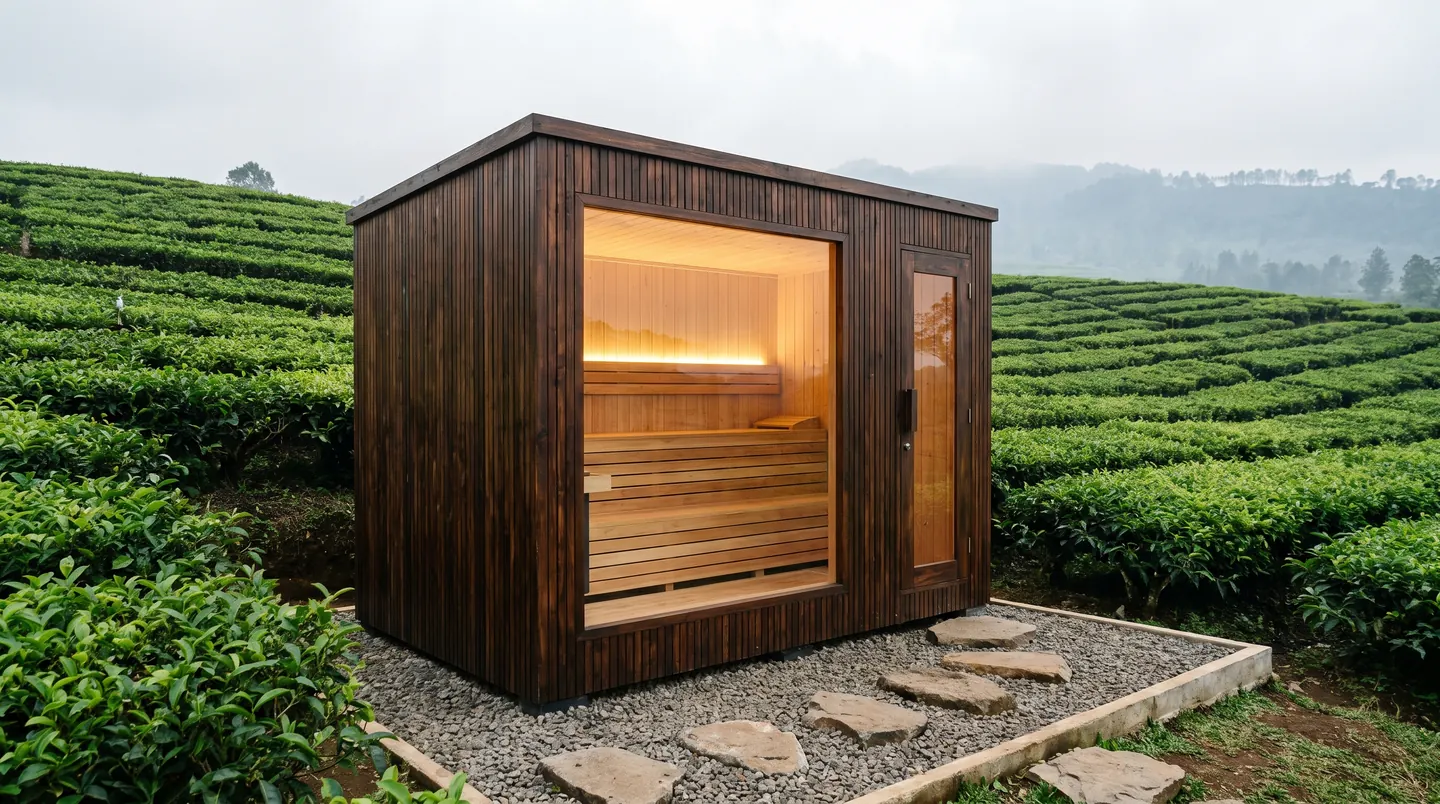
Finnish dry sauna, engineered for Bandung's climate
Dry heat at 80–95°C and 10–20% humidity. You sweat, the sweat evaporates, and you control the intensity yourself with a ladle of water on the stones.
Why the dry sauna is still the standard
The Finnish sauna has survived a century not out of tradition but because the physics are right. Dry air at 90°C transfers heat slowly enough that your body can respond, while sweat still evaporates and cools the skin. That is why 90°C dry is comfortable and 45°C wet is brutal. And you stay in control: a ladle of water on the volcanic stones spikes the humidity for a moment — löyly — and the perceived heat jumps without the air temperature moving at all.
What we do differently
What determines a sauna's lifespan disappears the moment the walls close: a properly sealed aluminium vapour barrier, 50–75 mm of rockwool, an air gap, and intake/exhaust ventilation sized against room volume. In Bandung's humidity those three things separate a sauna that lasts ten years from one that grows mould in three. Our benches are assembled with no metal fasteners in contact surfaces — metal at 90°C burns skin.
Wood and heater
Western red cedar for aroma and stability, thermo-aspen if you want a bench that barely ever feels hot, hemlock for a tighter budget. Harvia-class heater, 6–9 kW depending on volume, with thermostat and over-temp cutout. We size the power against cubic metres, not floor area.
Specifications
| Operating temp | 80–95°C |
| Humidity | 10–20% |
| Timber | Western red cedar / thermo-aspen / hemlock |
| Heater | 6–9 kW, thermostat + over-temp cutout |
| Capacity | 2–6 people |
| Heat-up time | 35–45 minutes |
| Electrical | Dedicated circuit, see power guide |
| Warranty | 2 years structural |
| Lead time | 3–6 weeks |
Frequently asked questions
How long does a dry sauna take to heat up?
Roughly 35–45 minutes to reach 90°C from ambient, depending on volume and heater output. A timer control can have it ready for you on arrival.
Can it be retrofitted into a finished house?
Yes, provided you have roughly 1.2 x 1.2 m of floor with a 2.0–2.1 m ceiling, adequate electrical supply, and a path for ventilation to outside. Our free survey confirms all three before you commit.
Which wood is best for a sauna in Bandung?
Cedar and thermo-aspen are the safest choices — low thermal conductivity and stable through humidity cycling. The full comparison is in our best wood for a sauna article.
What does a session cost in electricity?
An 8 kW heater running 45 minutes of warm-up plus a 45-minute session uses roughly 8–10 kWh. The rupiah figure depends on your PLN tariff — we calculate it in the quote.
Start with a free survey
We come to your place in Bandung, measure, check the power, and tell you what's possible and what isn't. No cost, no obligation.