Try it with a tub and bagged ice before you think about Rp 38 million
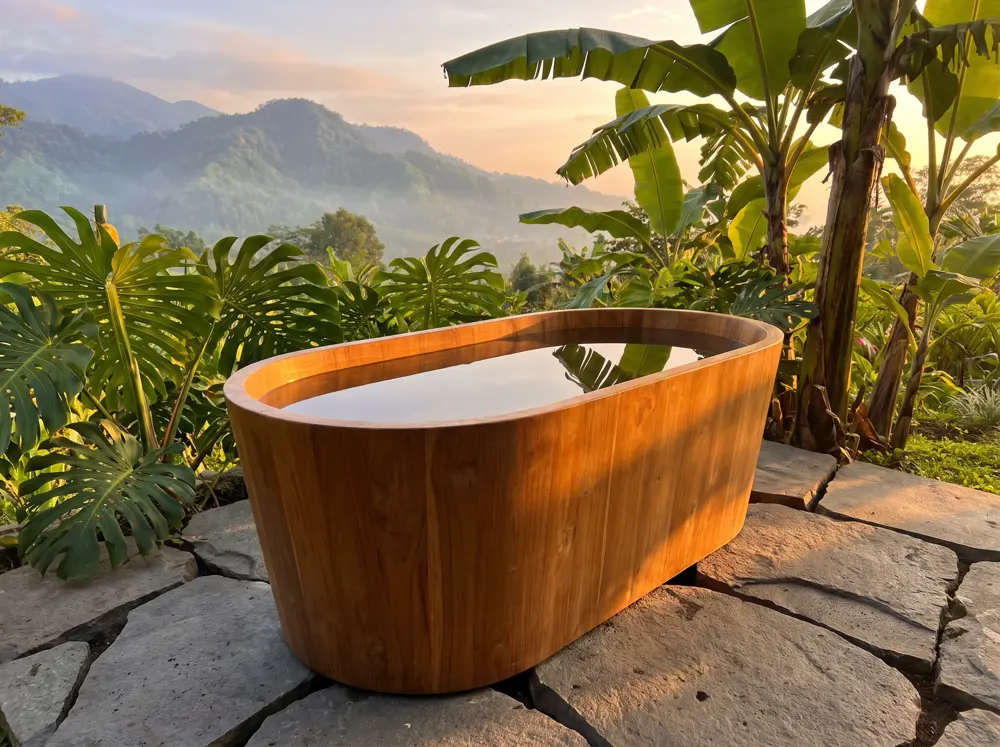
A 300-litre plastic tub in the garden, four bags of ice, ten minutes of waiting. That is your first ice bath, and it costs a rounding error against the units we build. If you are looking into a DIY ice bath, our most honest answer is: try it this weekend. Don't ask us first.
We sell ice baths from Rp 38,000,000, so this is a strange sentence for us to write. But we know something about the buyers: nearly everyone still using one a year later did the cold the cheap, uncomfortable way first. The ones who stop in month two never tried it first.
A DIY ice bath: three routes, and what you get
| Route | Temperature | Filtration | Honestly |
|---|---|---|---|
| 300-litre tub + bagged ice | ± 5°C going in, 11°C eight minutes later | None | Start here — it can run this weekend |
| Converted chest freezer | Stable, only with an external controller | None; draining is a chore | Cold and cheap. The electrical side is real |
| Chiller unit | A steady 2–8°C, around the clock | 20µm + UV or ozone | From Rp 38 million. Not about savings |
The first two can start this week. The third you need not decide now.
Two weeks is the test, and the test isn't about money
The most uncertain thing here is not the temperature, the filter or the chiller — it is whether you will do it on a wet Tuesday in month seven, once the novelty is gone. No specification answers that. Two weeks with a tub and ice does.
So do that first. If after two weeks you are still getting in without negotiating with yourself, you know something Rp 38 million cannot buy. If not, you saved Rp 38 million for a few bags of ice — a good outcome, not a failure.
One thing favours you: Bandung's 18–20°C evenings at 750 m mean your tub starts far colder than it would in Jakarta, so the same 40 kg of ice goes further.
Cold exposure isn't for everyone, and this applies before session one, not after week three. If you are pregnant, or have a heart condition, uncontrolled blood pressure or epilepsy — talk to a doctor first. Three rules apply without exception: never alone at first, never after alcohol, never submerge your head. The cold shock response raises heart rate and blood pressure within seconds — in the first moments, not at minute three. Start warmer and shorter than you think you need.
Limit one: a moving temperature means you're guessing
Forty kilos of ice gives roughly 5°C going in and roughly 11°C eight minutes later. Both are true, and that is the problem: you are not sitting at a temperature, you are sitting down a curve — and it differs every session.
The dose is temperature times duration, not either alone. Three minutes at 4°C and three at 11°C are not the same session, even if the stopwatch agrees. If the temperature moves and you are not measuring it, you are guessing — differently each week.
That does not make ice useless. It means you need a thermometer and a log: temperature in, out, duration. The cheapest item here, and the only one turning a pile of ice into something repeatable. The ladder is in our ice bath temperature guide.
Limit two: the water — and this is the real DIY failure
Cold slows bacteria; cold sterilises nothing. Bacteria at 4°C don't die, they reproduce patiently. The sly part is the optics, not the biology: cold water looks clear long past the point it deserves to be sat in. An untended tub can look like bottled water while biofilm grows on the walls.
Your tub holds 300–400 litres, not a pool's 50,000, so the load per litre is far higher. Whoever gets in has often just finished training — sweating, pores open. And the DIY version has no cartridge, no UV, no circulation.
The good news: the answer is cheap, and not chemical. Rinse 30 seconds before you get in — that removes most of the sweat, oil and deodorant that would become your water's problem. Cover the tub; left open overnight in a Bandung garden it collects leaves and insects before anyone touches the water. And with no filtration, drain far more often than you think — the interval follows bodies, not the calendar. Slippery walls or a smell mean drain it, not chlorinate it. Reasons in ice bath water maintenance.
Limit three: the chest freezer, and the electrical part
The most popular DIY route, and the logic is sound: it is built to get cold, and holds temperature far better than a pile of ice. We won't tell you not to do it — we will say this plainly, once, then stop.
A chest freezer is a 220V mains appliance never designed to hold water, let alone water and a person; its cabinet cannot resist 300 litres pushing on every seam and the drain plug. And what usually ends this project isn't a leak: many units run condenser tubing inside the cabinet walls, and one screw into that kills it instantly.
Unwrapped: water and mains electricity in one box, and people modify it. If you do it anyway, three things are not optional — a 30 mA earth-leakage breaker on its circuit, no changes to the internal wiring or compressor, and switching it off at the socket before you get in.
Two practical points. A freezer is built to go below 0°C, so without an external temperature controller it freezes your water solid. And draining one is a chore, so people put it off — that delay turns limit two from theory into a problem. On wet-room electrics, see sauna power requirements.
The ice arithmetic: a year of bagged ice versus a chiller
This is usually calculated dishonestly, so here are our assumptions — replace any of them. One session needs roughly 40 kg of ice. Block ice prices vary; check your nearest ice plant and substitute. We use Rp 1,250 per kg:
- Per session: 40 kg × Rp 1,250 ≈ Rp 50,000
- Three sessions a week ≈ Rp 650,000 a month
- A year ≈ Rp 7.8 million, plus around 156 trips to buy ice
A 0.5–1 HP chiller runs on standard 220V and costs roughly Rp 90,000–180,000 a month, or Rp 1.1–2.2 million a year — a gap of about Rp 6 million.
| Bagged ice, 3× a week | Chiller unit | |
|---|---|---|
| Running cost, per year | ± Rp 7.8 million | ± Rp 1.1–2.2 million |
| Up front | A fraction of Rp 38 million | From Rp 38 million |
| Temperature | Moves through the session | Steady 2–8°C |
| Filtration & sanitising | None | 20µm + UV or ozone |
| Your time | ± 156 ice runs a year | Zero |
| Its cost follows | Sessions you do | The calendar — runs whether you do or not |
Now the honest part. A Rp 6 million gap against a Rp 38 million unit is a payback around six years — and only if you plunge three times a week, every week. Anyone showing you a two-year payback is using the wrong ice price or a frequency you will not keep. So, plainly: the chiller does not pay for itself. You buy it for a temperature that holds, water you never think about, and no more dawn trips for ice.

And look at that last row, because it inverts the whole thing: the ice bill follows your sessions, the chiller's follows the calendar. Once a week ice wins outright; five times a week the chiller wins far sooner. Which is why your first two weeks are not a test of endurance — they are the only way to learn your real frequency.
When to move up, if you need to
No universal rule, but three signals repeat among people who end up happy with a built unit:
- Six months in without negotiating with yourself, and your frequency has settled at three times a week or more.
- The ice run has become the reason you skip sessions — the most common one, and not about money.
- More than one person uses it, or you want a measurable progression — and there the water stops being tidiness and becomes engineering.
If none apply, a tub and bagged ice is right, and we have no argument against it. Our ice bath specification is there if you need it. A sauna is a far harder DIY calculation — if that is your next direction, read building a sauna yourself first.
The most valuable ice bath isn't the coldest one. It's the one you actually get into on a Tuesday.
If you decide to do it yourself, we respect that. Between jobs our team does remote consultations at no charge — remote, so you need not be in Bandung. Send your plan, tub dimensions and photos of the spot over WhatsApp, and we will say honestly whether it works in your case and what to watch for. No quote follows, no obligation. If the answer is "your tub is fine, don't buy anything", that is what you will hear.
This article is provided for information only. We accept no responsibility for the outcome of work you carry out yourself, and any electrical work should be carried out by a licensed electrician.
Frequently asked questions
Can you make your own ice bath at home?
You can, and it is how we suggest starting. A 300-litre tub and a few bags of ice is enough to plunge this weekend, at a tiny fraction of what a built unit costs. What you don't get is a stable temperature or filtered water, and neither of those becomes a real problem until you know you'll stick with it.
How much ice do you need for an ice bath?
Roughly 40 kg to bring a normal-sized tub to a useful temperature, which gives you about 5°C going in and about 11°C eight minutes later. The exact figure depends on your tub volume and how warm the water was beforehand. In Bandung, 18–20°C evenings mean your water starts colder than it would in Jakarta, so the same ice goes further.
Can you turn a chest freezer into an ice bath?
People do it, but two things need saying. A freezer is a 220V mains appliance never designed to hold water, so a 30 mA earth-leakage breaker is essential and the internal wiring must not be modified; many units also run condenser tubing inside the cabinet walls, which a single screw will kill instantly. You also need an external temperature controller, because a freezer left to itself will turn your water into a solid block.
Does a DIY ice bath need a filter?
If you have no filter and no UV, the substitute is draining far more often — the interval follows how many bodies got in rather than the calendar, and without filtration it falls to days rather than weeks. Cold water slows bacteria but sterilises nothing, and it keeps looking clear long after it stops being fit to sit in. A 30-second rinse before you get in and a cover on the tub are free, and they beat any chemical.
Is buying ice cheaper than running a chiller?
It depends entirely on frequency. Assuming 40 kg per session and three sessions a week, ice comes out around Rp 7.8 million a year against roughly Rp 1.1–2.2 million of chiller electricity — a gap of about Rp 6 million, which means a Rp 38 million unit does not pay for itself in any reasonable timeframe. A chiller is bought for stable temperature and maintained water, not to save money.
Information on this site is educational and is not medical advice. Consult a doctor before starting heat or cold therapy.

Which parts of a sauna forgive you, and which parts punish you
We have pulled apart DIY saunas with tidier joinery than our own workshop produces. The wall behind them was black.
Sauna safety: safe for most people, genuinely risky for a few
The most dangerous thing in a sauna is not the 90°C. The article every company selling these should write, and almost none do.
Sauna power requirements: check the supply before you choose, not after
The quote was signed and the cedar chosen. Then our surveyor looked at the meter, and the project stopped for five weeks.
Start with a free survey
We come to your place in Bandung, measure, check the power, and tell you what's possible and what isn't. No cost, no obligation.