Sauna power requirements: check the supply before you choose, not after
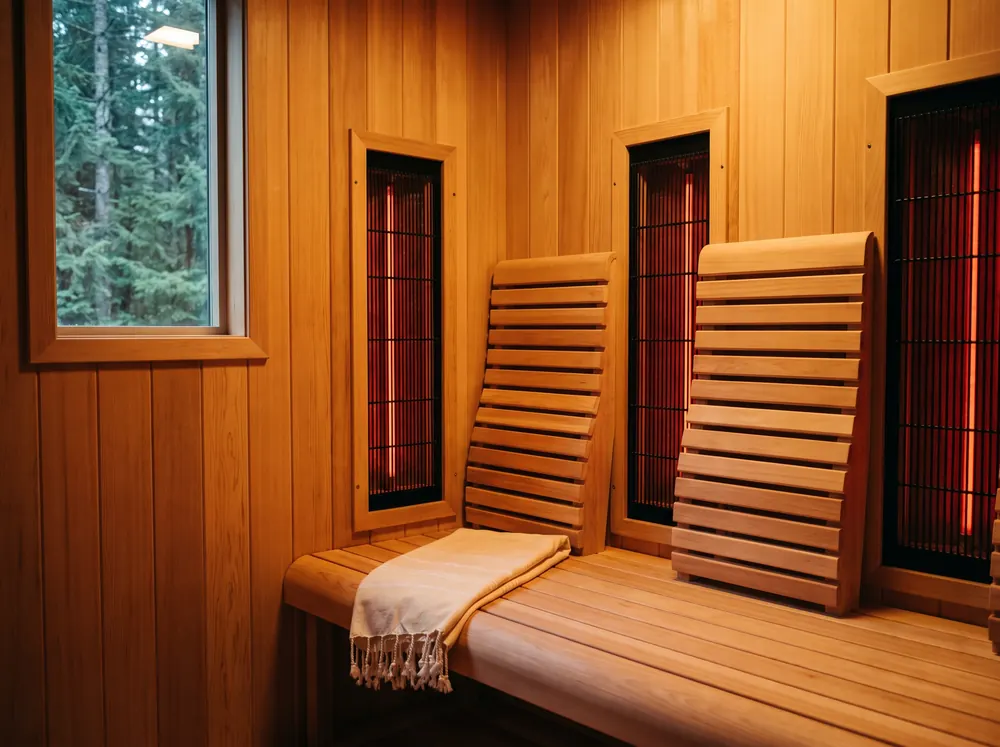
The quote for a 6 kW dry sauna was already signed. Cedar chosen, 3D layout approved, deposit paid. Then our team looked at the panel and found a 2,200 VA meter already carrying two air conditioners, a water heater and a pump. The project stopped five weeks — not because of the sauna, but because of the queue to upgrade the supply. Sauna power requirements are the first thing to check, not the last.
This is the step everyone skips, and the most expensive to fix afterwards. A 6–9 kW dry sauna heater is not a plug-in appliance: it needs a dedicated circuit, correctly sized cable, its own breaker, and often more capacity than your house has. That last one cannot be bought forward with money.
Sauna power requirements start with one number: your PLN capacity
If you moved here recently, this is a number you have never looked at. Every property in Indonesia is connected at a fixed capacity — daya, sold by the utility PLN in VA and printed on every bill. Homes sit at 900, 1,300, 2,200, 3,500, 5,500, 7,700 VA, then 11,000 and up.
It is a hard ceiling enforced by the main breaker: exceed it and the house goes dark, sauna included. At 900 or 1,300 VA the honest answer is short — no real sauna fits. If you rent, the upgrade is the landlord's decision, not yours.
PLN sells VA; appliances are labelled in watts. For a resistive load like a sauna element the power factor is close to 1, so 6 kW is roughly 6,000 VA — treat them as one number. The shortcut breaks on motors: an ice bath chiller draws more VA than its label suggests, and its startup inrush is briefly far above its running current.
What your house already draws before the sauna switches on
The sauna does not run in an empty house. Add up what is already on at the hour you want to use it — usually the evening:
- 1 PK air conditioner ≈ 750 W · 2 PK ≈ 1,500 W
- Instant water heater 2,500–3,500 W · storage tank 350–800 W
- Water pump 250–500 W · refrigerator 100–150 W
- Lights, TV, router, chargers: 300–500 W you never think about
A typical Bandung house with two air conditioners, a water heater and a pump already holds 2,500–4,000 VA at peak. Add a 6 kW heater and you are asking that meter for 8,500–10,000 VA. At 7,700 VA it works if you are disciplined — air conditioning off while the sauna heats. At 11,000 VA you never think about it again. We recommend the second where budget allows, because discipline is the first thing to disappear around month three.
What each product actually needs
| Product | Appliance load | Minimum PLN capacity | Cost per session |
|---|---|---|---|
| Small infrared sauna | 1.8 kW | 2,200 VA | ± Rp 1,700 |
| Infrared sauna, 2–3 people | 2.4–3 kW | 3,500 VA | ± Rp 2,000–2,800 |
| Dry sauna, 2–3 people | 6 kW | 7,700 VA | ± Rp 9,500 |
| Dry sauna, 4–5 people | 8 kW | 11,000 VA / 3-phase | ± Rp 13,000–14,000 |
| Outdoor barrel sauna | 8–9 kW | 11,000 VA / 3-phase | ± Rp 17,000–18,000 |
| Steam room | 6 kW | 7,700 VA | ± Rp 4,000–5,000 |
| Ice bath (0.5–1 HP chiller) | 0.4–0.9 kW | 2,200 VA | ± Rp 5,000–10,000 / day |
Every cost assumes Rp 1,700/kWh — substitute the rate on your own bill, since bands differ and tariffs are revised periodically. The method matters more than the number, and it is below.
Look at the steam room row: same 6 kW as the dry sauna, less than half the running cost. A steam generator reaches working temperature in about a dozen minutes; a dry cabin spends 40 minutes heating timber and stones first. Heat-up time, not the kW rating, sets your bill.
Cable, breakers, and why it must be a dedicated circuit
A 6 kW heater at 220 V draws around 27 A; a 9 kW draws around 41 A. The socket on your wall is designed for 10–16 A. Wiring a sauna heater into a circuit that feeds a bedroom is not a budget compromise — it is hot cable inside your ceiling.
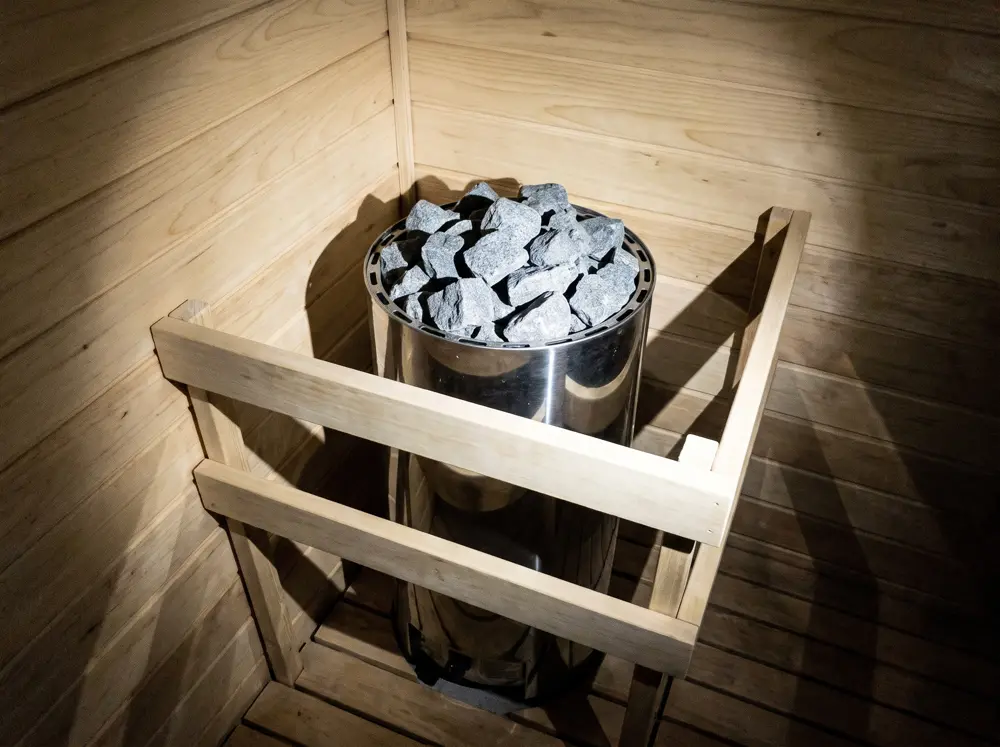
The rule: one dedicated circuit from the main panel, nothing else on that run, its breaker sized to the cable rather than the other way round. Indicative figures:
- Infrared, 1.8–3 kW — 8–14 A · NYM 3×2.5 mm² · 16 A breaker. Still its own circuit, standard plug or not.
- 6 kW heater, single phase — ± 27 A · NYM 3×4 mm² · 32 A breaker.
- 8 kW heater, single phase — ± 36 A · NYM 3×6 mm² · 40 A breaker.
- 9 kW heater, single phase — ± 41 A · NYM 3×6 mm² · 50 A breaker.
- Ice bath chiller, 0.5–1 HP — 16 A breaker, sized for compressor inrush.
Those are starting points, not drawings. Run length, installation method and ambient temperature all move them, and a licensed electrician signs off. One thing we never negotiate in a wet room: a 30 mA earth-leakage breaker.
Single phase or three phase
Above 7,700 VA, PLN generally offers three phase, and for a sauna that is not merely "bigger". A 9 kW heater split across three phases draws about 13.6 A per phase: lighter cable, smaller breaker, less voltage drop on a long run to the back garden. If your villa is already three phase, most of this article ended a paragraph ago. If not, and you are heading towards a wellness area with an ice bath eventually, going three phase once is cheaper than upgrading twice.
Upgrading capacity: the cost is the calendar
You apply through the PLN Mobile app or by calling 123. The fee scales with the size of the jump — get the figure from PLN, not from a contractor's estimate, ours included. For most people it is small next to the sauna. The time is not: if your street's network can carry it, think days; if it needs network or transformer work, think weeks. Our lead time is 3–6 weeks. Run both queues in parallel and you lose nothing. Run them in sequence and you lose a month.
Raising capacity can move you into a different tariff band, and higher bands pay more per kWh. Your fridge, your air conditioning and your iron all get more expensive — not just the sauna. The difference is small per kWh but applies to every kWh in the house, every month, permanently. Ask PLN which band you land in before you apply.
Why so many people end up with infrared
Honestly: most customers who choose an infrared sauna over a dry sauna do not choose it because the carbon panels are superior. They choose it because 2.4 kW fits the meter they have and 6 kW does not. That is legitimate, and we build them happily.
What we will not do is pretend it is the same thing. Infrared runs at 45–60°C; a dry sauna runs at 80–95°C with 10–20% humidity. Different sensation, different ritual, and no water on stones. The market sells infrared as "the more efficient sauna" — that is a seller's framing. More accurate: a different appliance with real advantages — 10–15 minutes to heat instead of 40, a standard 220V plug, a third of the running cost. What you trade away is in our infrared versus traditional sauna comparison.
Do the arithmetic yourself
kWh = kW × hours × load factor, then multiply by your tariff. Load factor is the part the internet forgets: a heater does not run flat out — the thermostat cuts it once temperature is reached, then cycles. A real example, 6 kW dry sauna for 2–3 people:
- 40 minute heat-up, essentially continuous: 6 × 0.67 × 1.0 ≈ 4.0 kWh
- 45 minute session, thermostat cycling at roughly 35%: 6 × 0.75 × 0.35 ≈ 1.6 kWh
- Total ≈ 5.6 kWh × Rp 1,700 ≈ Rp 9,500 per session
Three sessions a week is about 67 kWh a month, or Rp 114,000 — roughly one air conditioner used sensibly. Bandung evenings at 18–20°C add heat-up time, so add 10–15% to the heating portion, especially for an outdoor barrel. For the budget outside electricity, see what a home sauna actually costs.
The electricity a sauna burns is almost never the problem. Getting the electricity to it is.
An ice bath does the maths differently
A 0.5–1 HP ice bath chiller runs on standard 220V and will not worry your panel, but its logic is inverted: it does not run when you use it, it runs to hold water at 2–8°C around the clock. Tub insulation, a lid and ambient temperature set the bill — not how often you get in. The cool air here helps: a chiller on a shaded Bandung terrace works far less than the same unit in Jakarta. Budget 3–6 kWh a day; the lid is the cheapest thing you will ever do for that number.
The right order
- Read the capacity off your meter today. Five seconds.
- Add up what already runs at the hour you want the sauna.
- Then choose the product. Not the other way round.
- If you need an upgrade, apply the day you approve the design — not after the cedar is cut.
Our site survey and 3D layout are free across Bandung, and the first thing our surveyor looks at is the panel, not the room. If you want a number for your own house, send a photo of your meter and panel on WhatsApp — enough for an honest answer, and sometimes the honest answer is to wait.
Frequently asked questions
How much power does a sauna need?
A dry sauna for 2–3 people uses a 6 kW heater and realistically needs at least 7,700 VA of PLN capacity. An infrared sauna is far lighter at 1.8–3 kW and usually fits within 2,200–3,500 VA. The figure has to be calculated on top of what your house already draws, not in isolation.
Can I install a sauna on a 2,200 VA connection?
A small 1.8 kW infrared cabin can work, as long as the air conditioning and water heater are not running at the same time. A 6 kW dry sauna cannot — 6,000 VA alone exceeds the meter before you count a single light bulb. That needs a capacity upgrade first.
How much does it cost to run a sauna in Indonesia?
A 6 kW dry sauna uses about 5.6 kWh per session, so three sessions a week lands around Rp 110,000–120,000 a month assuming a Rp 1,700/kWh tariff. An infrared cabin is roughly a third of that. Running cost is almost never the obstacle — the connection is.
How long does a PLN capacity upgrade take?
If the network in your street can already carry it, days. If network or transformer work is needed, several weeks, and there is no way to accelerate it. Apply at the same time you order the sauna rather than afterwards.
Does a sauna need a dedicated electrical circuit?
Yes, including infrared cabins. A 6 kW heater draws around 27 A while a normal socket is rated for 10–16 A, so it needs its own run from the main panel with correctly sized cable and breaker. Add a 30 mA earth-leakage breaker because this is a wet room, and have a licensed electrician do the work.
Information on this site is educational and is not medical advice. Consult a doctor before starting heat or cold therapy.
A villa wellness area lives or dies on circulation, not equipment
The best sauna money can buy, placed on the wrong path, ends up as a towel cupboard.

Ice bath for athletes: the temperature is not the hard part
Everyone asks how cold the water should be. Almost nobody asks what time to get in, and that is the answer.
Ice bath water maintenance: cold slows bacteria, it doesn't sterilise
An ice bath is 400 litres of water that people sweat into straight after 15 minutes at 90°C. Cold doesn't solve that problem — it conceals it.
Start with a free survey
We come to your place in Bandung, measure, check the power, and tell you what's possible and what isn't. No cost, no obligation.