A villa wellness area lives or dies on circulation, not equipment
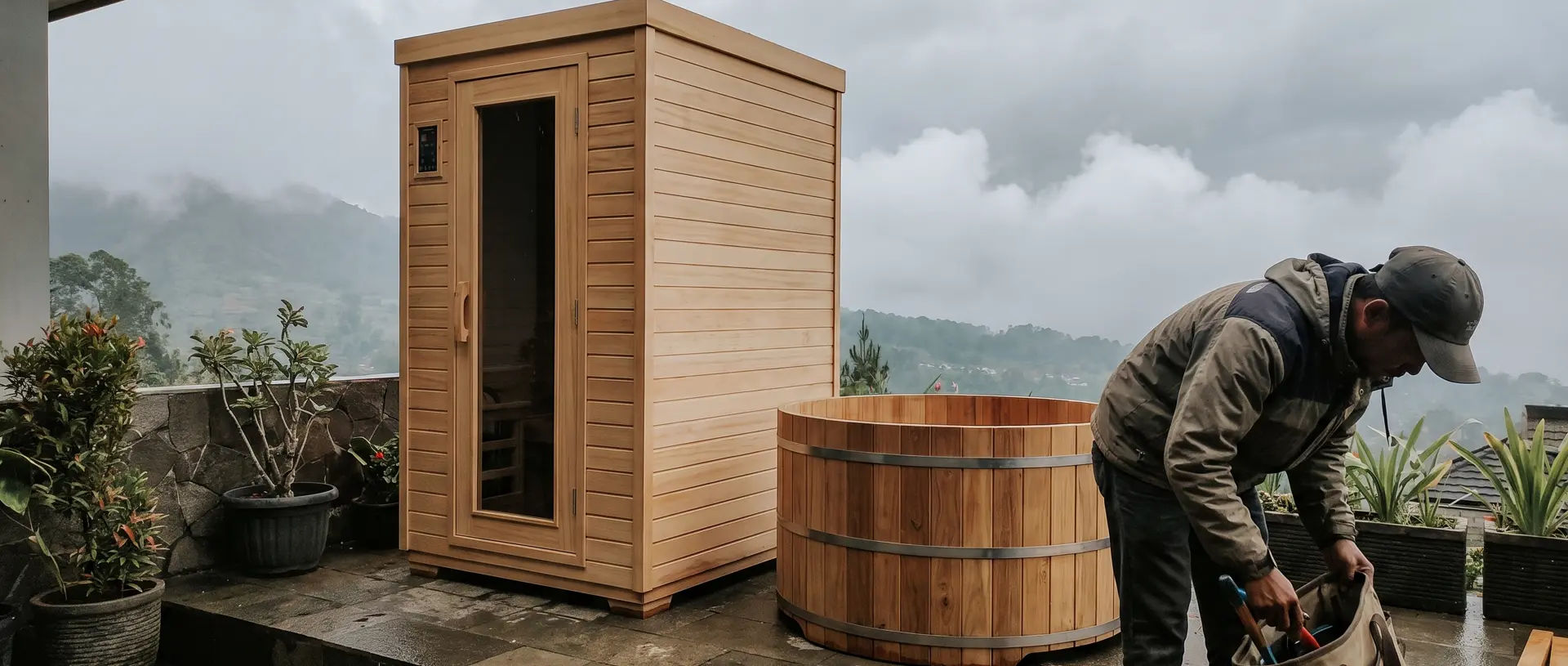
A villa in Lembang. A 3x2 metre cedar sauna, beautifully built, window facing the valley. The ice bath is good too. It just sits on the back terrace, and getting to it means walking through the living room. In the first year the sauna was used four times. Not because it was a bad sauna. Because nobody wants to cross a sofa soaking wet.
This is the most expensive and most common mistake in a villa wellness area: treating it as a shopping list of equipment rather than a single path someone has to walk wet, barefoot, core temperature two degrees up. Hot, cold and rest are not three products. They are one loop. Break it at any point and the room stops being used.
The loop: hot, cold, rest, repeat
The protocol we recommend is simple: 10-15 minutes hot, 1-3 minutes cold, 5-10 minutes rest, two or three rounds. Rewrite that as physical movement and you have a design specification. Your guest walks sauna to plunge three times, and plunge to chair three times, dripping wet, inside one hour.
Six trips. If each is five steps, nobody thinks about it. If each is twenty steps and goes through a door, the session feels like a chore. If it crosses a carpeted room, there is never a second session.
Our target is 3-5 steps between zones. It is the number we hold on every 3D layout we produce, and the first thing we check on an architect's plan.
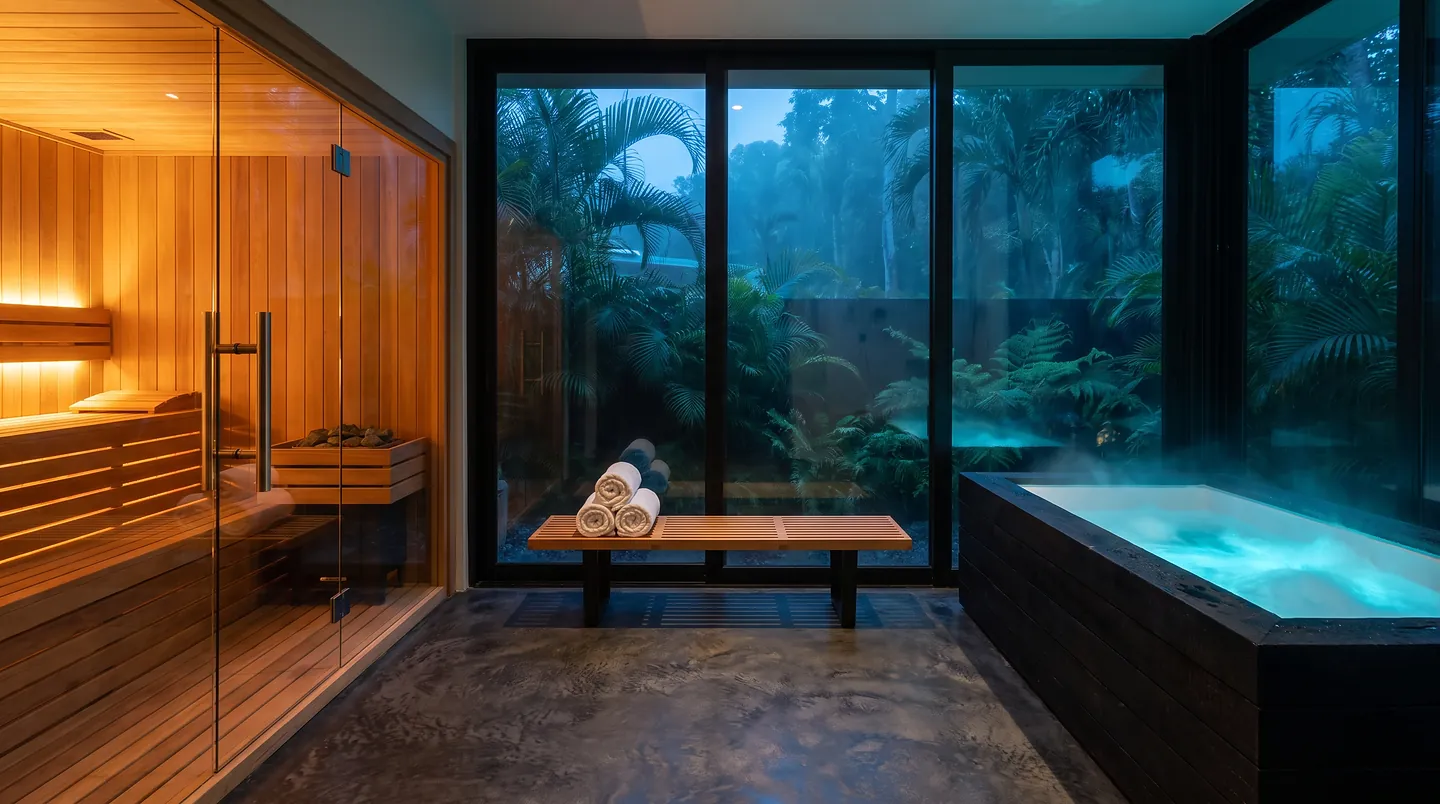
The three zones of a villa wellness area, and what each one needs
| Zone | Typical area | Temperature | Non-negotiable requirement |
|---|---|---|---|
| Hot zone (dry sauna, 2-4 people) | 4-6 m² | 80-95°C | Inlet and outlet ventilation, vapour barrier, dedicated 6-9 kW supply |
| Rinse shower | 1-1.2 m² | Hot water | Sits between hot and cold, own floor drain |
| Cold zone (ice bath) | 2-3 m² plus 1 m clearance | 2-8°C | Floor falls to drain, wet-barefoot slip rating, 220V in a dry room |
| Rest zone | 6-10 m² | Ambient, 18-20°C in Bandung | A chair you can lean back in, no chiller noise, a view |
| Plant room / chiller | 1.5-2 m² | Ambient | Ventilated, 3-4 m from the rest chairs, serviceable access |
Drainage: the single most regretted omission
If you take one sentence from this page: put in more floor drains than you think you need, and fall the floor before the tiles go down.
The arithmetic is unglamorous. Someone climbing out of an ice bath carries water with them. Three rounds, three people, and you have a puddle that keeps relocating all session. It has to go somewhere, and gravity is the only system in this room that never breaks.
The numbers we work to: a floor fall of 1.5-2% toward the drain, roughly 1.5-2 cm of drop per metre. Enough to move water, not enough to feel underfoot. Separate drains for plunge and shower, because one drain means one failure point and one source of smell. And a grating you can lift without a screwdriver, because what blocks it is hair.
This is the only item here you cannot fix later. Everything else is reversible once the villa stands: move a chair, change a light, quiet a chiller. You cannot re-fall a poured, tiled floor without demolishing the room. We have seen it around Bandung Barat, and the fix is always expensive.
Three things, in order. Steps from the sauna door to the ice bath: more than five and we propose a new layout. Where the water goes: no floor drain on the drawing gets marked in red. Where the chiller sits relative to the rest chairs. Survey and 3D layout are free inside Bandung, and we would rather do them before the concrete is poured than after.
Surfaces: floors are not slippery, wet floors are
Every tile feels safe in a showroom. What decides it is how it behaves under a one-millimetre film of water, with a foot fresh out of 4°C: cold, slightly numb, less responsive than usual.
Specify textured tile or stone with a slip classification for wet barefoot areas. If your supplier only talks in R numbers, ask for R11 or better; if they talk in barefoot classes, ask for class B or C. Timber decking with 5-8 mm gaps works just as well. Avoid polished stone, glossy tile and sharp tub edges. Inside the sauna, use timber: stone in a 90°C room is a quick way to burn your guests' feet.
The plant room: the acoustic mistake you cannot see on a drawing
An ice bath chiller is a compressor, and compressors make noise: a constant low hum with a fan that cycles on and off. On the spec sheet the number looks small. In the rest zone at nine in the evening, when the point of sitting there is to think about nothing, it feels much larger.
The rest zone is the quietest room in the cycle. Putting it against the plant room is the most efficient way to ruin the only part of the session that carries real value. Our rule: the plant room sits at least 3-4 metres from the rest chairs, with one solid wall in between, never a thin partition.
But it cannot sit too far away either. Every metre of pipe between chiller and tub is heat leaking back into the water and extra work for the compressor. We aim for under 6 metres of insulated run. The room also has to breathe: a chiller in a sealed cupboard fights its own exhaust until it fails. Upkeep consequences in our ice bath water maintenance notes.
Power and water: decide before the concrete goes down
A 6-9 kW dry sauna heater needs a dedicated run: three-phase, or a genuinely heavy single phase, straight from the board with its own protection. Not something you plug into the nearest socket, and not something added tidily once the walls are closed. Detail in sauna power requirements.
The chiller is far more relaxed: 0.5-1 HP on standard 220V. What needs thought is not the load but the location. The socket belongs in a dry plant room, not beside the tub.
For water: one fill point near the tub, one drain line that can empty it without a bucket, and hot water to the rinse shower. That shower is not a luxury. It keeps your plunge water clean and your filters alive longer.
Glass, views, and why Bandung changes the answer
At 750 metres of altitude, evenings here drop to 18-20°C, and that number rewrites the design. In Jakarta or Surabaya the rest zone has to be indoors and air conditioned, because sitting in 30°C air after a 90°C sauna resolves nothing: your body has no route to shed heat, and all you get is sweating for longer in a different room.
Here the outside air does that job for you, free, every evening. The best rest zone in Bandung or Lembang is an open terrace, or a roofed one with open sides. Your skin dumps heat into 19°C air, the breeze moves, and you get the slow cooling phase that in Jakarta costs a one-horsepower compressor. A technical argument, not a romantic one, though the view happens to be good too.
The consequences are concrete. Sauna and plunge on the sheltered side, chairs outside, a roof honest about afternoon rain. Big sauna glazing should face the rest zone or the valley, not the neighbour's wall. And do not forget the vapour barrier: the humidity here makes sauna wall construction far less forgiving than in a dry climate.
Lighting as wayfinding
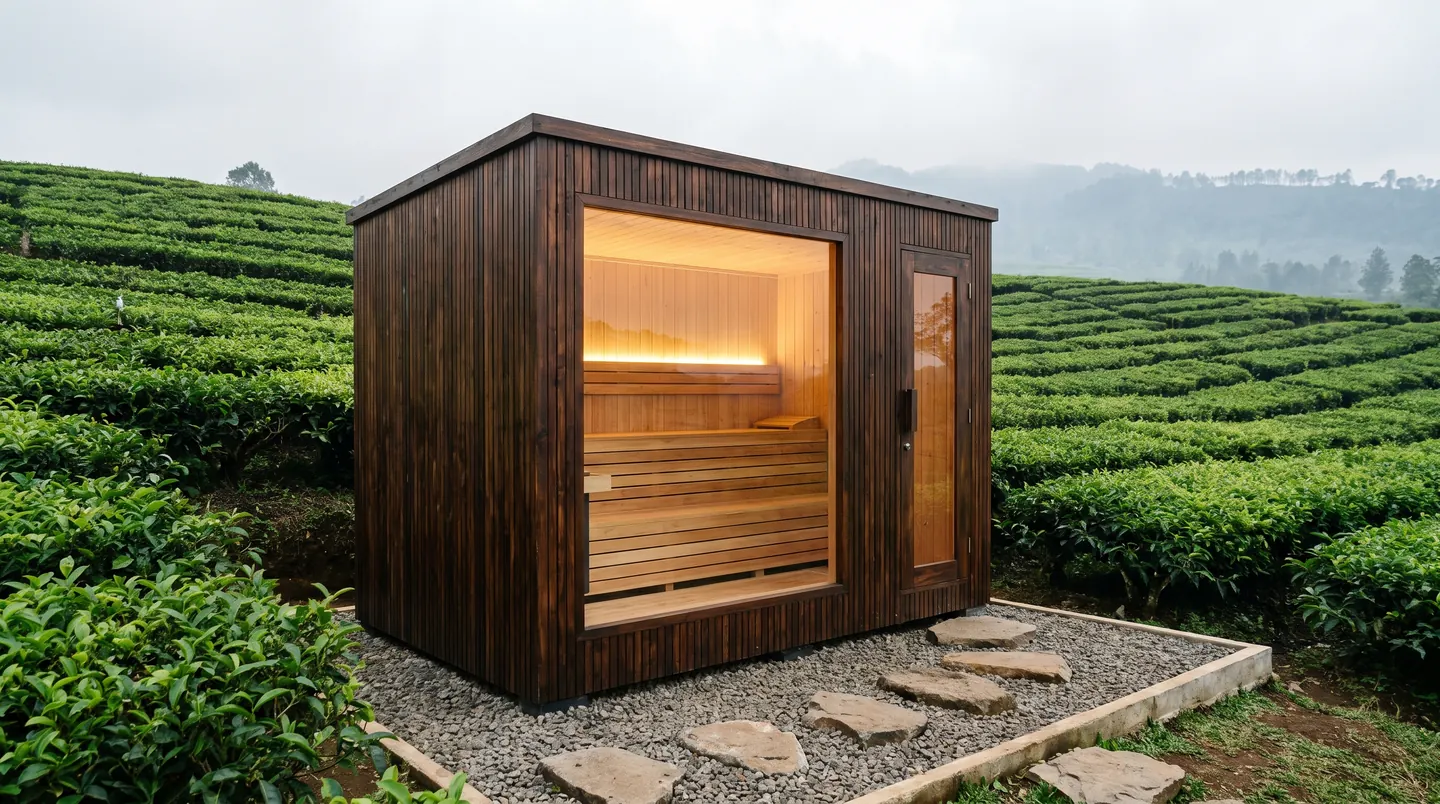
Warm light in the hot zone: 2200-2700K, dim, ideally from under the bench or behind the backrest. More neutral and slightly brighter at the plunge, around 3000-3500K, enough to see the water and the tub edge. The rest zone gets the dimmest of the three.
The reason is not only mood. Someone who has just walked out of a 90°C room is not in a sharp thinking state, and moves by following whatever feels right. A shift in colour temperature is a cue the body reads without translating: warm means hot, cool means cold, dark means sit down. You do not need signage if the light explains it. And no fitting should glare from a reclined position. Check it from the chair, not the doorway.
Budget, and the right order of decisions
A complete wellness area, dry sauna plus ice bath, installed, starts from Rp 145,000,000, with a typical lead time of 3-6 weeks. Our pricing page breaks that down by component. But the order of the decisions matters more than the figure.
Circulation path first. Then drainage. Then the plant room. Only then equipment. Almost everyone does it backwards: they pick a sauna, look for somewhere to put it, then wonder why the room never gets used.
An ordinary sauna on the right path gets used three times a week for ten years. The best sauna on the wrong path becomes a towel cupboard.
The difference is almost always settled on the floor plan, not the shopping list. If you are planning a villa, our wellness area page carries example layouts, and our team will read your drawings before the builders start. For why the hot-cold-rest loop is arranged the way it is, start with the contrast therapy guide.
Frequently asked questions
How much space do you need for a villa wellness area?
Around 16-20 m² covers a 2-4 person sauna, an ice bath, a rinse shower and a small rest zone, plus a separate 1.5-2 m² for the chiller. Total area matters less than shape, though: a long narrow 20 m² room can work far worse than a square 16 m² one, because the walk between zones gets stretched out.
Should the rest zone be indoors or outdoors?
In Bandung, outdoors is usually the better answer. Evening temperatures of 18-20°C do the cooling work that you would have to buy with air conditioning in Jakarta. A roofed terrace with open sides tends to make the best rest zone here, as long as it is sheltered from afternoon rain and direct wind.
How much does a villa wellness area cost in Bandung?
A complete wellness area with a dry sauna and ice bath starts from Rp 145,000,000 installed, with a typical lead time of 3-6 weeks. The figure moves with your choice of timber, the sauna size, and how much civil work such as drainage and electrical runs has to be reopened.
Will the ice bath chiller noise disturb villa guests?
It can, if the plant room is in the wrong place. A chiller is a compressor with a constant low hum, and the rest zone is the quietest part of the whole cycle. Give it at least 3-4 metres and one solid wall between the two, and the problem disappears.
Can a wellness area be added to a finished villa?
Yes, and most of our projects are exactly that. The expensive part is never the sauna, it is drainage and power: re-falling a tiled floor and pulling a 6-9 kW run into a closed-up room are the two items that push the budget hardest. Send the drawings first so we can price it before anything gets opened up.
Information on this site is educational and is not medical advice. Consult a doctor before starting heat or cold therapy.
Ice bath for athletes: the temperature is not the hard part
Everyone asks how cold the water should be. Almost nobody asks what time to get in, and that is the answer.
Ice bath water maintenance: cold slows bacteria, it doesn't sterilise
An ice bath is 400 litres of water that people sweat into straight after 15 minutes at 90°C. Cold doesn't solve that problem — it conceals it.
A commercial sauna for hotels is a different machine from a home one
The same 8 kW heater runs 150 hours a year in a home and 5,800 in a hotel. Every spec difference falls out of that one number.
Start with a free survey
We come to your place in Bandung, measure, check the power, and tell you what's possible and what isn't. No cost, no obligation.