Sauna safety: safe for most people, genuinely risky for a few
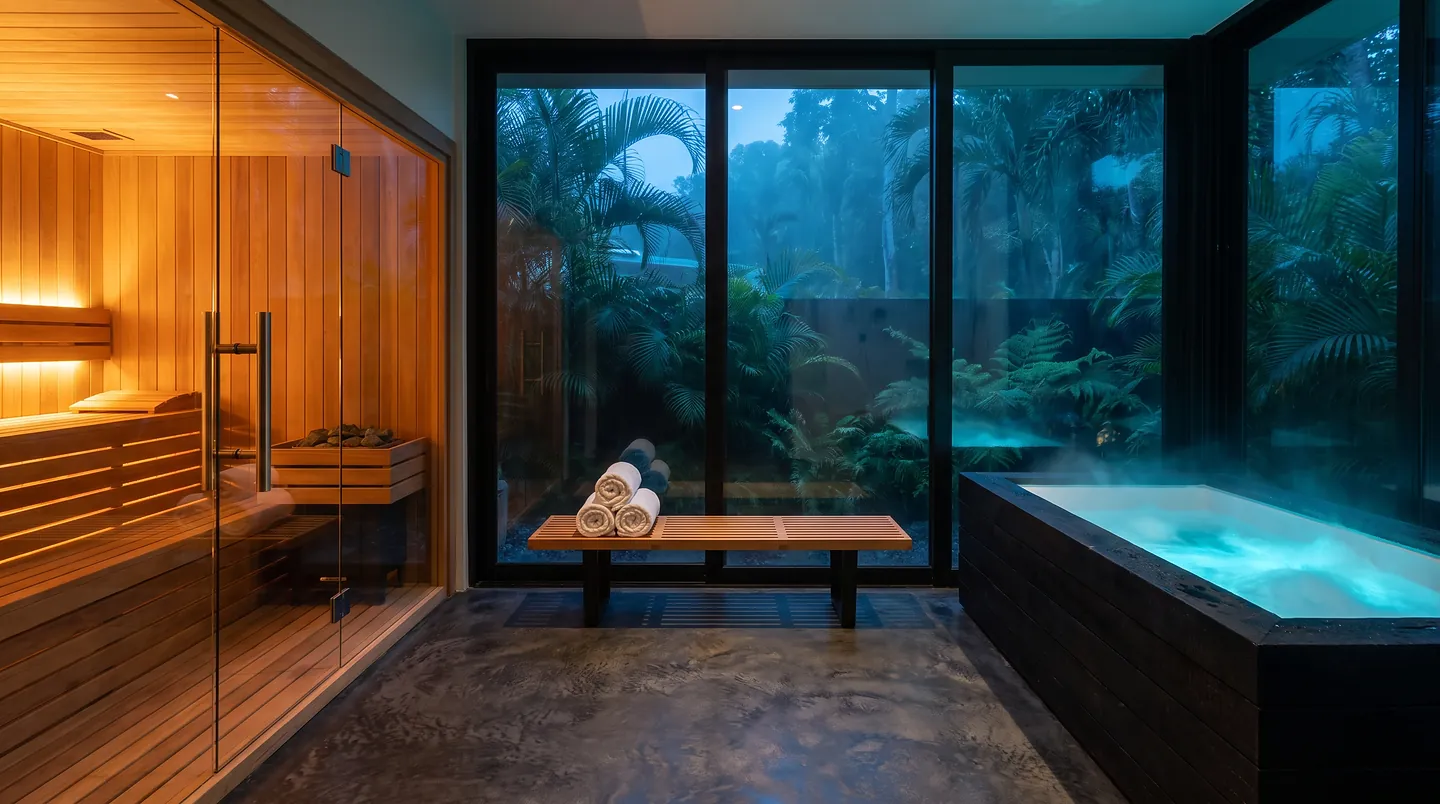
The most dangerous thing in a sauna is not the 90°C. It is the two beers before you went in, and a door that was hung to open inwards. Sauna and cold plunge are safe for almost every healthy person — and genuinely risky for a specific few. Sauna safety is the article a company selling these should write at length, and almost nobody does. This is ours: not alarmist, not dismissive.
We have been building saunas and ice baths in Bandung for three years, more than 100 projects. Nearly every problem we have heard about traces back to three things: alcohol, someone pushing past a signal their body was already sending, and a cabin built without thinking about what happens if a person faints inside it. The first two are yours. The third is your contractor's.
Who must talk to a doctor first
Not "should" — must, before the first session. The list is short and specific:
- Pregnancy. Core body temperature is a consideration of its own, and not territory for guessing.
- Any heart condition — previous heart attack, arrhythmia, heart failure, stents, a pacemaker. Heat raises heart rate; cold water raises it again while also raising blood pressure.
- Uncontrolled high blood pressure. Well-controlled on medication is often a different conversation — but that is your doctor's call.
- Epilepsy.
- Recent surgery, unhealed wounds, or an active skin infection.
- Before starting cold exposure — anyone, including the healthy. Water at 2–8°C is not a colder shower; the response is qualitatively different.
Two cold-specific ones that almost always get missed:
- Raynaud's phenomenon — fingers that blanch, turn blue, then go numb in the cold.
- Cold urticaria — hives triggered by cold. Rare, and plenty only discover it the first time. A reaction on your palm holding ice is one thing; your whole body submerged is another.
If none of that applies and you are healthy, research into heat and cold exposure is broadly encouraging and many users report feeling better afterwards. But it is not settled, and no sentence here replaces a doctor who knows your history.
Alcohol: the one sauna safety rule we do not negotiate
There is no "just one". If you take a single thing from this page, take this one: alcohol and saunas never go together.
The mechanism is not complicated. Alcohol dilates blood vessels; so does a sauna. Together they drop your blood pressure further than either alone — precisely as you stand up to leave. Alcohol also interferes with temperature regulation and accelerates dehydration. But the worst part is none of those: it degrades your judgement exactly when your judgement is the only safety system left. People who fall asleep in a 90°C room do not wake themselves up.
This covers the morning after, too. A sauna is not a hangover cure — you would walk in already dehydrated, the exact opposite of the starting point you want.
The rule that follows is just as serious: never plunge alone. Not because 4°C water will drown a healthy person, but because the one genuinely bad scenario — losing consciousness in water — only ends well if somebody else is there to see it. If the house is empty, postpone. That is the whole rule.
The signs that mean get out now
| Sign | What it probably is | What you do |
|---|---|---|
| Dizziness, light-headedness, narrowing vision | Blood pressure dropping as vessels dilate | Get out, sit or lie down, feet up, drink |
| Nausea | You are starting to overheat | Out now. Do not finish the round |
| Headache | Dehydration or too long a session | Out, drink, stop for the day |
| Tingling or stabbing pain in the fingers | Longer than you can take today | Out of the water, rewarm passively, do not push |
| Violent shivering that will not stop | Losing heat faster than you can replace it | Dry off, warm clothes, gentle movement, warm drink |
| An irregular, pounding heartbeat | Needs assessing, not ignoring | Stop the session, call your doctor |
| Confusion, slurred speech, trouble focusing | A serious sign | Out with help, seek medical attention |
The rule fits in one sentence: in doubt means out. No session is worth negotiating with a symptom over, and the sauna will still be there tomorrow.
The first 30 seconds in cold water
The dangerous part of an ice bath is not the third minute — it is the first second. Skin contact with water at 2–8°C triggers the gasp reflex: one deep involuntary breath you cannot suppress, followed by uncontrolled fast breathing for roughly 30–60 seconds, plus a spike in heart rate and blood pressure. Normal physiology, not a sign something is wrong, and it settles on its own.
The problem is simple: if that gasp happens while your face is under water, it stops being normal. So the rules never change — get in slowly holding on, do not jump, do not dive, do not submerge your head, never hold your breath to prove a point. Sit, let your breathing fall apart for half a minute, then watch it settle by itself. If it does not, get out. Every ice bath we build has an edge you can hold and an obvious way in — not an aesthetic decision.

Medication, age, and drinking water
Several classes of medication affect the body's ability to regulate temperature, hold blood pressure, or even sense heat: diuretics, beta blockers and other blood pressure drugs, antihistamines, some antidepressants and antipsychotics, stimulants. We are not pharmacists and the list is not complete. If you take anything regularly, one question to your doctor or pharmacist — "does this change how my body handles heat and cold?" — closes this chapter.
Children heat up faster than adults: a small body has a lot of skin surface relative to its mass, and children are far worse at noticing they have had enough. If a child goes in: always accompanied, on the cooler lower bench, much shorter sessions, out the moment they get bored — not a second later. For older adults the issue is rarely the heat itself but the combination of medication and blood pressure. Again: a doctor, not a contractor.
Hydration is not mystical. Drink a large glass of water before you go in, not only afterwards, and do not use thirst as your signal — it arrives late. If you come out with a headache, that is usually the answer.
The safety that is built into the cabin, not stuck on its wall
Half of this is decided before anyone walks in. That half is our responsibility — and a fair list to interrogate any contractor in Bandung with, including us:
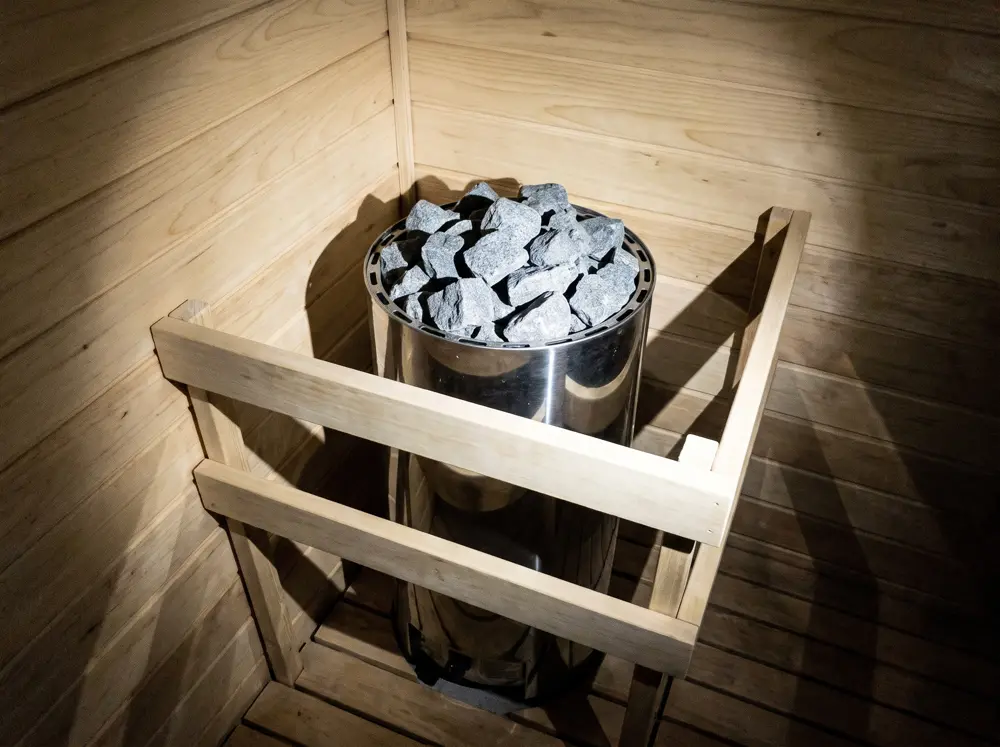
- A heater guard. The stones on top of a heater are far hotter than the 90°C air around them, and people fall towards things when dizzy. A timber rail at the manufacturer's specified clearance is not an accessory.
- A door that opens outward and never locks. Magnetic or roller catch only — pushed open by someone panicking, or by someone who has fallen against it. A sauna never has a key, a latch or a bolt. If anyone offers one, you know everything you need to know about that contractor.
- A thermostat and an over-temperature cutout. Two different devices. The thermostat regulates; the cutout kills power if the thermostat or its sensor fails. The first is for comfort, the second is so there is no fire.
- A run-time limit timer. The heater has to switch itself off, because one day somebody will forget.
- A 30 mA earth-leakage breaker. Wet skin and electricity share a room. It is part of the sauna power requirements we never negotiate.
- Ventilation. In Bandung — 750 m, 18–20°C evenings, high humidity — ventilation and the vapour barrier matter more than in Jakarta. Low inlet near the heater, outlet on the opposite wall: air exchanges, the cabin dries after a session, and nobody sits in stale air.
- Non-slip flooring. In our field experience across Bandung, the most underrated risk in a wellness area is not the heat — it is wet tile, stepped on by someone who just left 4°C water on half-numb feet.
The protocol we recommend, and why it is conservative
10–15 minutes hot → 1–3 minutes cold → 5–10 minutes rest, repeat 2–3 rounds, then finish however you prefer. Those numbers sit deliberately on the conservative side; we would rather you left feeling you could have done more than left being carried. The variations are in our contrast therapy guide, and how cold the water needs to be is in the ideal ice bath temperature — the answer is almost always "less cold than you think".
The internet enjoys arguing about whether to finish hot or finish cold. There is no settled answer, and anyone selling you one as a hard rule is selling you something. Finish whichever way leaves you comfortable.
A safe sauna is not the hottest or the coldest one. A safe sauna is the one you can leave at any moment, in any condition, without turning anything.
We build saunas and ice baths — we are not medical professionals, and this page is not medical advice. Research into heat and cold exposure is promising but unsettled, and nothing above replaces a doctor who knows your history. If you are pregnant, have a heart condition, uncontrolled high blood pressure, epilepsy, or recent surgery — or you are simply unsure — ask first. The sauna is not going anywhere. Ask us the engineering questions, and your doctor the medical ones.
Frequently asked questions
Is a sauna safe if you have high blood pressure?
Uncontrolled high blood pressure is a reason to speak to a doctor before your first session, not after it. For many people whose pressure is well controlled on medication the answer is often different, but that is your doctor's judgement rather than a sauna builder's. Take your list of medications with you when you ask.
Can you use a sauna while pregnant?
Pregnancy is on the list of conditions to discuss with a doctor first, and that applies to both saunas and ice baths. Core body temperature is a consideration of its own here and it is not territory for guessing. Ask your obstetrician rather than a forum.
How long is it safe to stay in a sauna?
The protocol we recommend is 10–15 minutes of heat per round, 2–3 rounds, with 5–10 minutes of rest between them. Those numbers are conservative on purpose. The rule that matters more than any stopwatch: if dizziness, nausea or a headache turns up, leave immediately without waiting for the timer.
Are ice baths dangerous?
For healthy people an ice bath is generally safe if you get in slowly, keep your head above water, and are not alone. The part that genuinely deserves respect is the first 30–60 seconds, when the gasp reflex and fast breathing happen automatically. Conditions like Raynaud's phenomenon, cold urticaria or any heart problem need a doctor's input first.
Can you drink alcohol before or during a sauna?
No, and this is the one rule we do not negotiate. Alcohol and heat both dilate blood vessels, so blood pressure drops further than either would alone, while alcohol also disrupts temperature regulation and degrades your judgement. The day after a heavy night is a bad time too, because you would start the session already dehydrated.
Information on this site is educational and is not medical advice. Consult a doctor before starting heat or cold therapy.
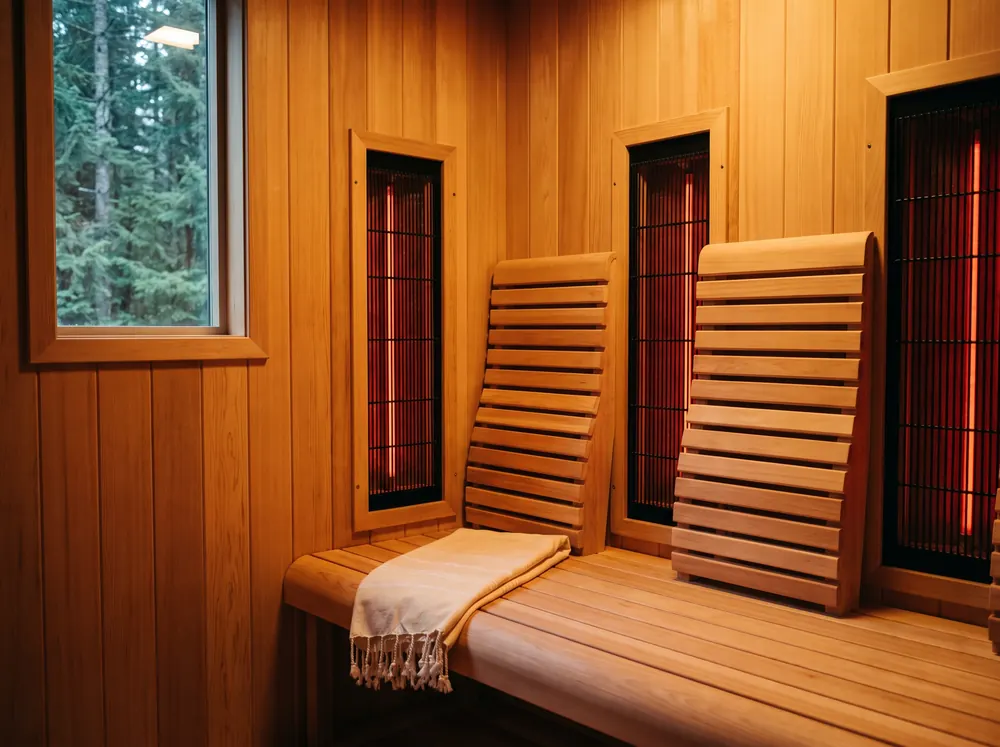
Sauna power requirements: check the supply before you choose, not after
The quote was signed and the cedar chosen. Then our surveyor looked at the meter, and the project stopped for five weeks.
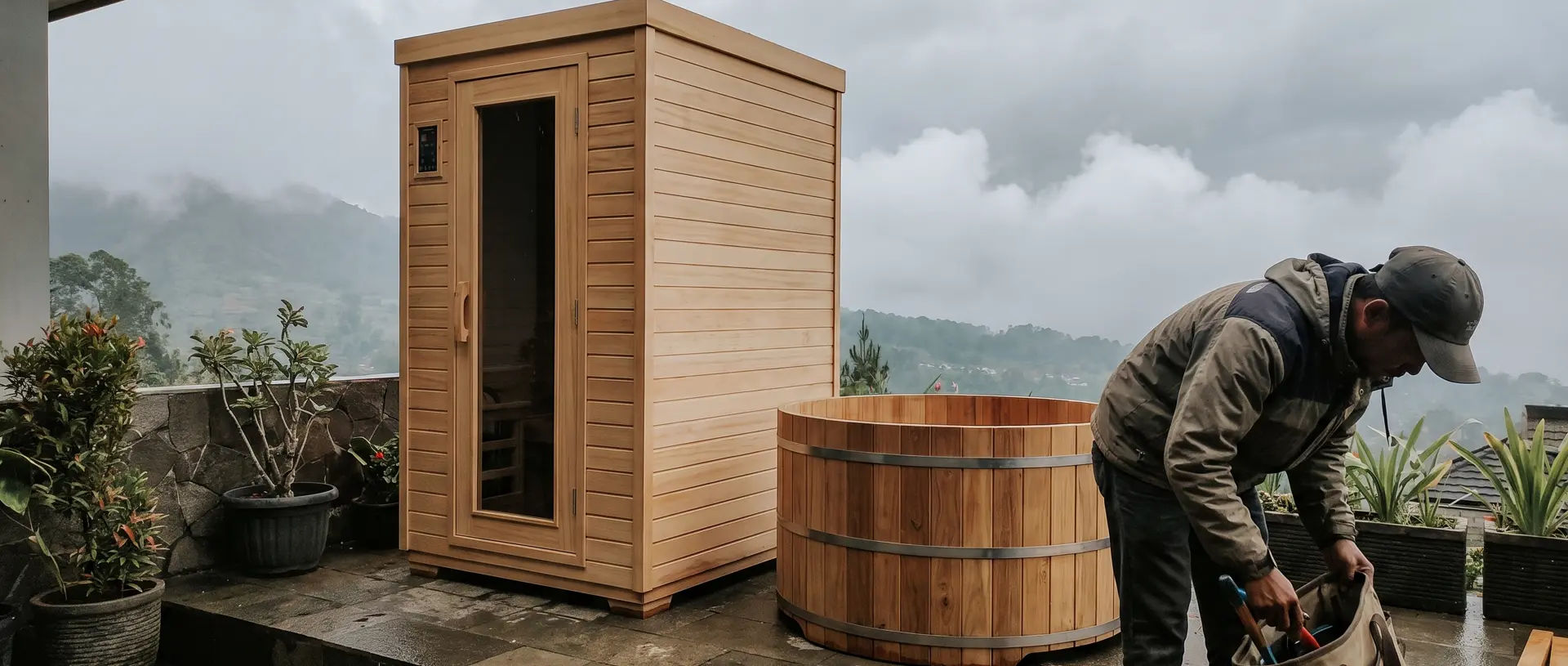
A villa wellness area lives or dies on circulation, not equipment
The best sauna money can buy, placed on the wrong path, ends up as a towel cupboard.

Ice bath for athletes: the temperature is not the hard part
Everyone asks how cold the water should be. Almost nobody asks what time to get in, and that is the answer.
Start with a free survey
We come to your place in Bandung, measure, check the power, and tell you what's possible and what isn't. No cost, no obligation.