Ice bath water maintenance: cold slows bacteria, it doesn't sterilise

A typical ice bath holds around 400 litres. A pool holds 50,000. The difference isn't just the zeros: in a pool, one person's sweat and skin oils disperse into 50,000 litres. In an ice bath, that same person contributes to 400 — and they stepped out of a 90°C sauna fifteen minutes ago, pores open, dripping. The load per litre can be a hundred times a pool's. That is why ice bath water maintenance is an engineering problem, not a tidiness one.
And here's what nobody mentions before you buy: cold water doesn't rescue you. It hides the problem.
Cold slows bacteria, cold does not sterilise
Low temperature suppresses microbial metabolism. That's true, and good news — at 2–8°C your water degrades far more slowly than a 38°C jacuzzi, which is functionally an incubator. But "slower" is not "not". Bacteria don't die at 3°C; they reproduce patiently.
What makes this dangerous isn't the biology, it's the optics. Cold water looks clear long past the point where it deserves to be in the tub. If your jacuzzi goes cloudy, you know to act. An ice bath two months without care can still look like bottled water while biofilm grows on the walls, in the hoses, inside the pump. Clarity is a poor indicator — and the only one most owners use.
Ice bath water maintenance: the four things that work
We fit the same combination on almost every unit, from a home plunge in Dago to a high-volume gym install: 20µm cartridge filtration, UV or ozone sanitising, a chiller holding a stable temperature, and one rule needing no electricity.
1. 20µm cartridge filtration — catches stuff, not microbes
A filter sanitises nothing. Its job is to strip out dead skin, oils, deodorant and hair before any of it becomes food for microbes. Twenty microns is the right compromise at this volume — fine enough to catch what matters, coarse enough not to blind off in three days. It's the spec on every ice bath we build.
Circulation matters more than people expect. Still water is stratified water: the surface warms, the bottom chills, the filter never sees most of the volume. The pump must run even when nobody is plunging.
2. UV or ozone — the sanitising part
UV-C inactivates microorganisms as water passes the lamp chamber. Ozone oxidises contaminants and then decays back into oxygen. Both work on cold water without losing effectiveness — a real advantage over chemistry — and neither leaves a taste, smell, or residue on your skin.
The honest caveat matters: UV and ozone only treat water that physically passes through them. Neither has a residual — no lingering protection in the tub the way chlorine leaves one, so circulation isn't optional. And UV lamps have a sly failure mode: output drops well before the lamp dies. A glowing lamp isn't necessarily a working one. Replace on operating hours, not on "it's still on".
3. A chiller that holds temperature, not chases it
A 0.5–1 HP chiller on 220V isn't only about cold. An undersized one runs nearly continuously and still lets temperature creep up through the afternoon — and every degree accelerates everything you don't want. A stable 2–8°C is part of the sanitation system, not just the experience. Which number suits you is covered in our temperature guide.
4. Shower first — the rule that beats chemicals
The cheapest and most effective item on the list, and it has no model number. A 30-second rinse before you get in removes most of the sweat, oil, sunscreen and deodorant that would otherwise be your filter's problem. On commercial installs, one shower beside the tub does more for water quality than any filter upgrade. At home you enforce it on yourself — especially after a hot session, since contrast therapy means entering the cold at your sweatiest.
Why chlorine is a poor fit for cold water
Everyone asks: why not just chlorinate it? Three reasons, all real.
Chemistry slows in the cold. Oxidation rates fall with temperature, so chlorine that behaves neatly in a 28°C pool is markedly more sluggish at 3°C. Your instinct is to raise the dose — and that's where the second problem starts.
The bather load is too small and too irregular. A pool has a predictable load and a forgiving volume. An ice bath gets four people on Monday and nobody on Tuesday. Holding a stable residual in 400 litres against that means you're permanently too high or too low — and the gap between "not enough" and "overdosed" is millilitres.
Your tub isn't a pool. Over-chlorinated water attacks gaskets, pump seals and the chiller's heat exchanger — the most expensive parts of the system. Add the smell, and the skin irritation of three minutes in water you've overdosed.
Chlorine isn't forbidden: on high-load commercial installs a low dose sometimes makes sense alongside UV — as a supplement, never the substitute. But as the sole system on a home ice bath, it's a pool answer bolted onto a differently shaped problem.
A schedule you'll actually keep
The schedule we hand over with every unit. The right-hand column is the reason — a schedule without reasons is one nobody follows past month two.
| Frequency | What to do | Why |
|---|---|---|
| Every session | 30-second rinse before entry; cover the tub after | Your filter's biggest load arrives on skin, not through air |
| Daily | Net the surface; check temperature; confirm the pump circulates | Still water stratifies; the filter never sees the volume |
| Weekly | Hose the cartridge; wipe walls and waterline; log UV lamp hours | Biofilm is beaten mechanically, not chemically |
| Every 4–6 weeks | Soak the cartridge in degreaser overnight; clean cover and skimmer | Water doesn't dissolve oil, and oil blinds the filter |
| Every 2–3 months (home) | Full drain, scrub every surface, refill | The interval follows bather count, not the calendar |
| Weekly (gym) | Full drain | Dozens of sessions a day rewrites the arithmetic |
| Every 6–12 months | Replace the UV lamp or service the ozone generator; check pump seals and condenser fins | UV output falls before the lamp goes dark |
Biofilm isn't dirt; it's a microbial colony anchored to a surface under a protective slime layer. The signs are subtle: the wall feels slippery, almost soapy, under a fingertip — not thickly slimy, just "too smooth". A faint musty note in the first seconds after the pump starts. A thin waterline ring that returns days after you wiped it. Once a surface is slippery, sanitiser won't fix it — biofilm must be scrubbed off. That's why the weekly wipe isn't cosmetic.
When to actually drain it
The internet's answer — "monthly" — is a number invented because it sounds tidy. The real drain interval isn't a function of time, but of how many bodies went in. We count bathers, not dates. On a home unit used by one or two people a few times a week, working filtration and UV usually holds 8–12 weeks. On a gym unit, the arithmetic collapses to weekly.
Drain sooner, ignoring the schedule, if any of these show up: walls turning slippery; a smell despite fresh filtration; foam that won't clear, which is saturated oils and surfactants; or water that feels "thick" on your skin. Always drain fully when the unit sits idle over two weeks — still water with a dead pump is the worst case there is.

Cartridges: intervals and cost
The cartridge is a consumable, and it's the item people put off. Three rules:
- Hose it weekly. Outside-in, between the pleats. Never a pressure washer — that shreds the media rather than cleaning it.
- Chemical soak every 4–6 weeks. Water does not dissolve oil. Oil trapped deep in the pleats is the real blockage, and only a degreaser removes it.
- Replace when it won't come back clean after a soak, or the pleats go soft and splay. Home use is typically two to three a year; commercial, more.
On cost: one cartridge is a rounding error against a tub starting at Rp 38,000,000. The cartridge isn't the expensive part — deferring it is. A blinded cartridge drops flow; low flow means your UV isn't seeing enough water, your chiller works harder, and your pump seals pay for it. Buy two and rotate: one in, one drying. For the size and price for your unit, message us — we keep a spec sheet for every install.
A clean cartridge and a 30-second rinse rule beat any chemical you pour in.
What Bandung changes
Two things, and one is in your favour. Bandung's 18–20°C evenings at 750 m mean your chiller isn't fighting the way its Jakarta counterpart does: lighter thermal load, steadier temperature, lower bill. But high humidity and outdoor siting mean leaves, insects and dust land in the tub unless you cover it. A cover isn't an accessory; it's part of the filtration system. A tub left open overnight in a Bandung garden hands your cartridge a day's work before anyone touches the water.
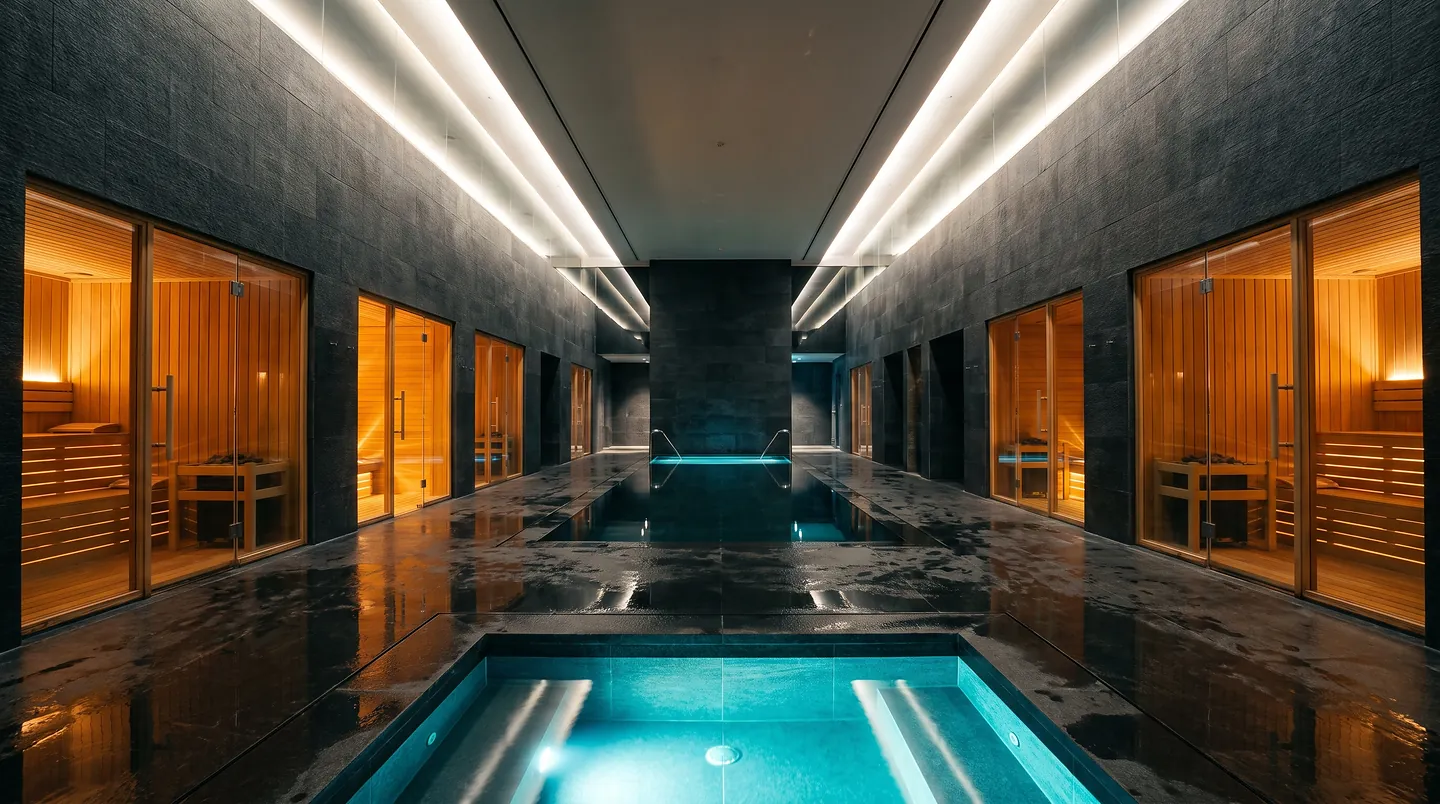
If your ice bath sits in a wellness area with a sauna, the order of use is a water question as much as a body one: every hot session not followed by a rinse is a deposit into your cartridge. For sports teams the numbers get tighter — see our guide for athletes.
One note outside the water question: if you're new to cold exposure, pregnant, or you have a heart condition, uncontrolled blood pressure or epilepsy — talk to a doctor first. Clean water doesn't make cold water right for everyone.
Frequently asked questions
How often should you change ice bath water?
The interval follows bather count, not the calendar. On a home unit with one or two people a few times a week, working 20µm filtration plus UV will usually hold 8–12 weeks; a gym unit with dozens of sessions a day needs a weekly drain. Drain sooner if the walls feel slippery, foam won't clear, or the water smells despite fresh filtration.
Do you need chlorine in an ice bath?
Usually not, and chlorine as the sole system is a poor fit for cold water. Reaction rates slow at 3°C, the small and irregular bather load means your dose is always wrong in one direction, and over-chlorinated water attacks pump seals and the chiller's heat exchanger. On high-load commercial installs a low dose can make sense alongside UV, but not instead of it.
Does cold water kill bacteria?
No. Cold slows microbial metabolism but sterilises nothing — bacteria at 3°C simply reproduce more slowly. The real trap is that cold water keeps looking clear long after it stops being fit to sit in, which makes clarity a misleading indicator.
How often should an ice bath filter be replaced?
Hose the cartridge weekly and soak it in degreaser every 4–6 weeks, because water doesn't dissolve oil and oil is the real blockage. Replace it when it no longer comes back clean after a soak or when the pleats go soft — typically two to three cartridges a year for home use. Buy two and rotate them so the unit never runs unfiltered.
Does an ice bath need UV or ozone?
One or the other, yes — that is the sanitising half of the system, and a cartridge filter does not do it. UV-C inactivates microorganisms as water passes the lamp, while ozone oxidises contaminants and decays back to oxygen; both stay effective at low temperature. Both only treat water that flows through them, so the pump has to keep circulating even when nobody is using the tub.
Information on this site is educational and is not medical advice. Consult a doctor before starting heat or cold therapy.
A commercial sauna for hotels is a different machine from a home one
The same 8 kW heater runs 150 hours a year in a home and 5,800 in a hotel. Every spec difference falls out of that one number.

Stop sizing your sauna by floor area
Two saunas, identical floor plan, identical heater. One works. The difference is 55 cm of ceiling.

Sauna wood is chosen with physics, not with taste
A 90°C bench doesn't burn you. A 90°C screw head does. That gap is the whole argument about wood.
Start with a free survey
We come to your place in Bandung, measure, check the power, and tell you what's possible and what isn't. No cost, no obligation.