Infrared vs traditional sauna: one heats you, the other heats the room
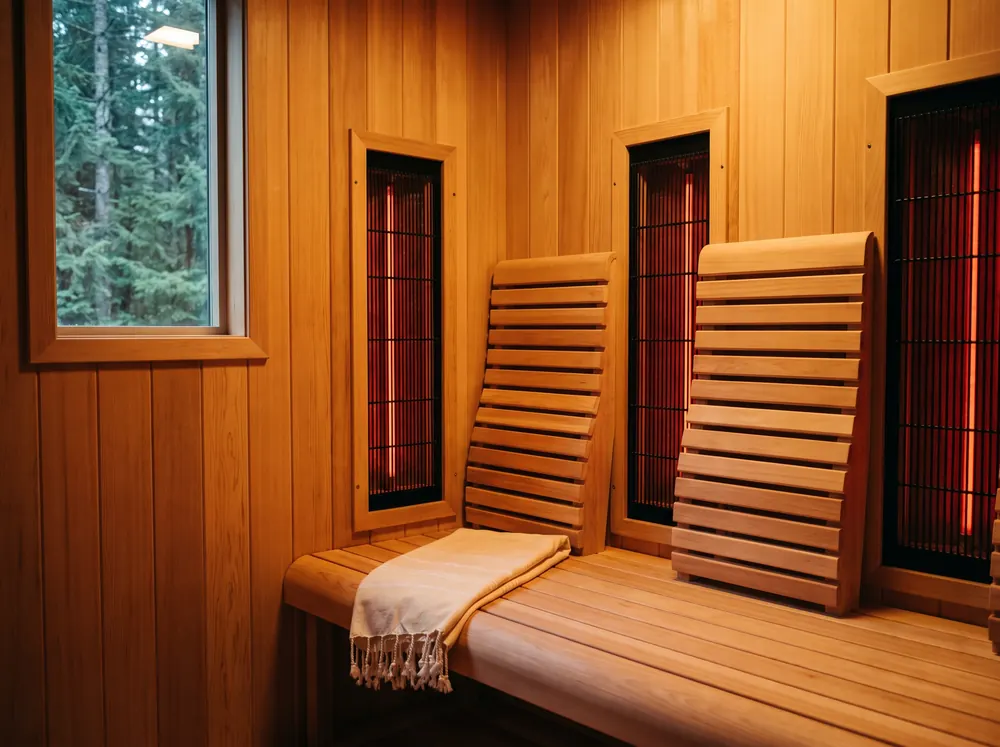
A 2.5 kW infrared cabin draws about 11 amps and plugs into a wall socket. An 8 kW Finnish heater draws 36 amps — three times as much — and will trip most Bandung houses before the first stone gets warm.
That gap isn't about brands or quality. In the infrared vs traditional sauna comparison, nearly everything else — temperature, warm-up, price, footprint, how it feels on your skin — falls out of one sentence: infrared heats you; a traditional sauna heats the room.
One fact that produces all the others
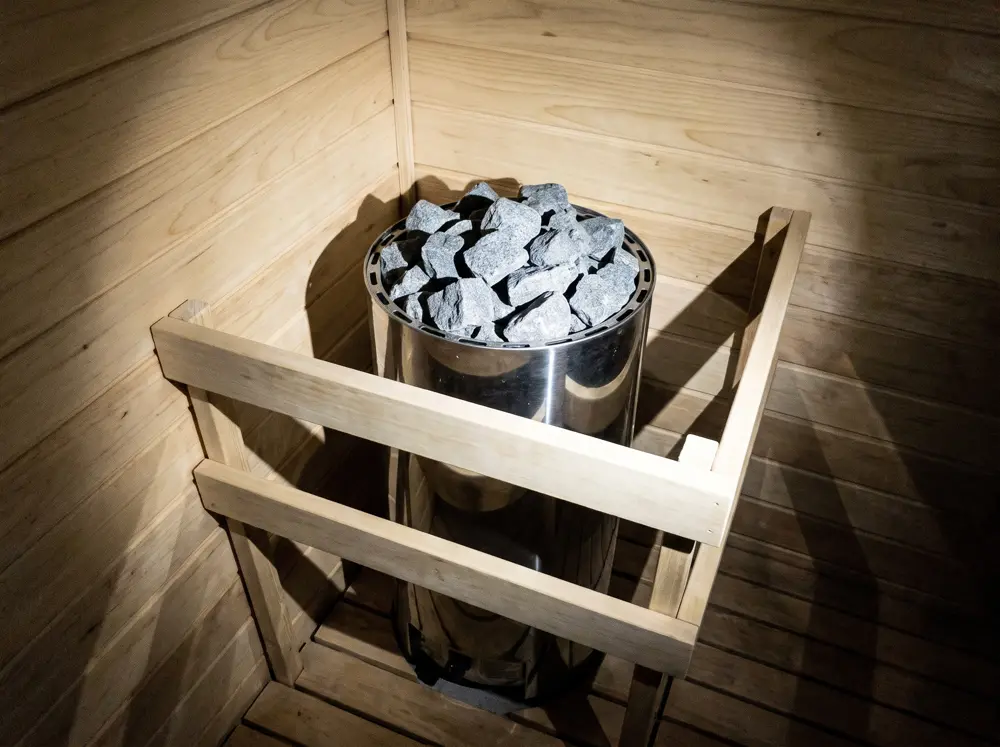
A traditional heater fills a room with energy. The stones go up until they glow, the timber comes up with them, the air reaches 80–95°C, and the cabin becomes a thermal battery. You walk into the heat. The air temperature isn't a side effect — it's the product you bought.
An infrared panel makes no attempt to heat the room. Carbon or ceramic emitters radiate infrared, your skin absorbs it, and the air drifts to 45–60°C as a by-product. If you measure the air temperature in an infrared cabin and feel short-changed, you're measuring the wrong thing. Here the air isn't the medium; it's the neighbour.
Everything else derives from that. Why only 1.8–3 kW? No tens of kilos of stone and no timber cabin to drag to 90°C. Why 15 minutes versus 45? Same reason: thermal mass. Why no löyly? No stones to throw water at. Why Rp 42,000,000 versus Rp 68,000,000? Mostly because there's less in the box.
Electricity: the part that usually decides before taste gets a vote
In an Indonesian house the aesthetic debate usually ends before it starts, and what ends it is the VA figure on your PLN meter. If you've just moved here: homes are supplied at a fixed contracted capacity. You cannot simply add a circuit the way you might in Europe — the utility caps the whole house, and the sauna shares that cap with your air-con, water pump and water heater. At 220 volts, watts divided by volts equals amps.
| PLN capacity | Total current (220 V) | Infrared 1.8 kW (8 A) | Infrared 3 kW (14 A) | Sauna 6 kW (27 A) | Sauna 9 kW (41 A) |
|---|---|---|---|---|---|
| 2,200 VA | 10 A | Marginal | No | No | No |
| 3,500 VA | 16 A | Yes | Marginal | No | No |
| 5,500 VA | 25 A | Yes | Yes | No | No |
| 7,700 VA | 35 A | Yes | Yes | Yes | No |
| 11,000 VA | 50 A | Yes | Yes | Yes | Marginal |
Read that table once and most people have their answer. A 2,200 VA supply — still very common in Bandung — stretches only to the smallest infrared cabin, and only with nothing else substantial running. A 6 kW sauna needs 7,700 VA minimum; a 9 kW one effectively needs 11,000 VA, and at that point you're asking one phase to carry 41 amps.
Which is where three-phase comes in. A 9 kW heater split across three phases becomes 3 kW per phase — about 14 amps per leg instead of one 41-amp monster. That's why almost every heater above 6 kW is wired that way; the detail is in our guide to sauna power requirements.
Before you compare a single catalogue, go and read the VA number on your PLN meter. That number decides which of these two products you can actually own — not your taste, not your budget. An upgrade to 7,700 or 11,000 VA can be applied for, but it costs money and time, and if you rent in Dago or Setiabudi that meter isn't yours to upgrade. For tenants the answer is almost always infrared.
What's missing: löyly, steam, and the whole ritual
There are no stones in an infrared cabin. No water on the rocks, no burst of steam, no aroma, no wall of heat arriving two seconds later. That moment — vapour condensing on your skin — is why people fall for Finnish saunas, and the mechanism is explained in dry sauna vs steam room.
If you've sat in a properly built Finnish sauna and loved it, an infrared cabin will feel like a different activity. Not worse. Different. That matters commercially too: a guest asking your hotel for a sauna means the room with the stones. An infrared cabin in a spa reads as a substitution.
How each one feels
Infrared is directional. The side of your back facing the emitter warms first; your front stays cool. Sweat arrives later and more gradually, and because the air is only around 50°C, most people sit 30–45 minutes without difficulty. That's the appeal and the design trap both: cheap cabins put every emitter behind your back and your shins never get any. A good cabin places emitters front, behind, and at calf height.
A traditional sauna envelops you. Heat arrives from every direction at once, there's a 15–20°C spread between your feet and your head, and a 10–15 minute round is plenty. You aren't sitting in front of the heat; you're inside it.
On detox: let's be honest, this is oversold
This is the most exaggerated corner of the market, and we'd rather lose a sale than repeat it.
Claim one: infrared "penetrates several centimetres into the tissue". That's checkable with physics, not a brochure. Carbon and ceramic emitters work in the 5–8 micrometre range. Water absorbs those wavelengths greedily, and skin is mostly water, so essentially all the energy lands in the outermost layer — well under a millimetre deep. The warmth you feel deeper gets there as it does in any sauna: conducted, then carried by blood. That isn't a criticism. Infrared works; it just doesn't work by the mechanism printed on the box.
Claim two: infrared sweat "removes more toxins". Sweat is mostly water and salt. The organs that clean your blood are your liver and kidneys, and neither is waiting on a cabin. The figures in the advertising — "several times more toxins" and similar — don't trace back to any source anyone can check. We won't repeat them, and you should be suspicious of a seller who does.
Sauna research is interesting but unsettled, and most of it is built on traditional Finnish sauna use — a different exposure from an infrared cabin, at a different air temperature with a different delivery mechanism. Assuming the findings transfer isn't justified. Many users report better sleep and looser muscles; that's a different claim from a medical one. If you're pregnant, have a heart condition, uncontrolled high blood pressure, or epilepsy, talk to a doctor first — same as before any cold exposure.
Infrared vs traditional sauna: the spec sheet
| Infrared sauna | Traditional (Finnish) sauna | |
|---|---|---|
| What gets heated | You | The room |
| Air temperature | 45–60°C | 80–95°C |
| Heat source | Carbon or ceramic emitters | Electric heater + stones |
| Power draw | 1.8–3 kW | 6–9 kW |
| Electrical supply | Standard 220 V socket; realistically 3,500 VA min. | Dedicated circuit; 7,700–11,000 VA min., often three-phase |
| Warm-up time | ~15 min | ~45 min |
| Energy per session (est.) | ~1.5 kWh | ~9 kWh |
| Löyly / steam | None. Never will be | Yes |
| Typical session | 30–45 min in one sitting | 10–15 min rounds, repeated 2–3 times |
| Footprint for two | ~1.2 × 1.2 m | ~1.5 × 2.0 m |
| Ceiling height | 1.95–2.0 m | 2.0–2.1 m and up |
| Partner for an ice bath | Workable; smaller contrast | Ideal |
| From | Rp 42,000,000 | Rp 68,000,000 |
Size and space
A two-person infrared cabin fits in roughly 1.2 × 1.2 m at 1.95–2.0 m high. No upper bench, no gradient to exploit, so a low ceiling costs you nothing.
A two-to-three person dry sauna wants about 1.5 × 2.0 m, and the height isn't comfort — it's function. You want roughly 1.0–1.2 m between top bench and ceiling so your head sits in the hottest air layer. Drop the ceiling and you lose the gradient that is the whole point. Add heater clearances and ventilation openings, and a traditional sauna always asks for more space than people expect. In a compact Bandung house that's the second argument after the electrics.
So which one?
- Take infrared if your meter says 3,500 VA and isn't going up; you want it four evenings a week without planning ahead; 90°C is genuinely too much for you; the space is tight; or the budget is Rp 42 million, not Rp 68 million. It's also the right answer for most renters — the meter belongs to your landlord.
- Take a traditional sauna if you want löyly and the ritual; you're pairing it with an ice bath and need a real heat load first — sequencing is in our contrast therapy guide; you run a hotel or gym and your guests know the difference; or you have the power and the room.
On contrast work, honestly: at 50°C you don't accumulate the heat load you would at 90°C, so the plunge lands blunter. That doesn't mean it fails — the contrast is just shorter. If contrast is the main goal, don't economise on the hot half. Full pricing for both is here.
Infrared isn't a cheap sauna, and a sauna isn't an expensive infrared. They sell heat through two different machines — and which is right for you is almost always decided by the electrical panel, not the brochure.
We've built both across Bandung, Lembang and West Java over the past three years. Book a site survey and 3D layout, free within Bandung. Usually we only need to see your meter and your room, and the question answers itself. WhatsApp.
Frequently asked questions
Is an infrared sauna better than a traditional sauna?
Neither is better — they're different products, not expensive and cheap versions of the same thing. Infrared wins on frequent use, tight spaces, and standard house electrics. A traditional sauna wins if you want löyly, enveloping 80–95°C heat, or a sharp contrast with an ice bath.
Can an infrared sauna run on a normal Indonesian house connection?
Usually yes, since an infrared cabin draws 1.8–3 kW from a standard 220 V socket. In practice you want a 3,500 VA supply or better; at 2,200 VA you're limited to the smallest unit and only with no other large load running. A 6–9 kW traditional sauna is an entirely different story and needs its own dedicated circuit.
Do infrared saunas really detox your body?
Not in the way the advertising means. Sweat is mostly water and salt, and what cleans your blood is your liver and kidneys, not your sweat glands. Claims about multiplying toxin removal don't trace back to any checkable source. Infrared still has real value — warmth, relaxation, and many users report better sleep — but that's a different claim.
How long does an infrared sauna take to heat up?
About 15 minutes, against roughly 45 for a traditional sauna. The difference isn't heater quality, it's thermal mass: infrared doesn't have to drag tens of kilos of stone and a timber cabin up to 90°C. That 30-minute gap is often what decides whether the thing gets used four times a week or four times a month.
Can you throw water on an infrared sauna?
No, and you shouldn't try. There are no stones to throw it at, the emitters and electronics aren't designed to be splashed, and there's no thermal mass to flash the water into steam anyway. If löyly and steam are what you want, you want a traditional sauna — that's the one experience infrared cannot deliver at any price.
Information on this site is educational and is not medical advice. Consult a doctor before starting heat or cold therapy.
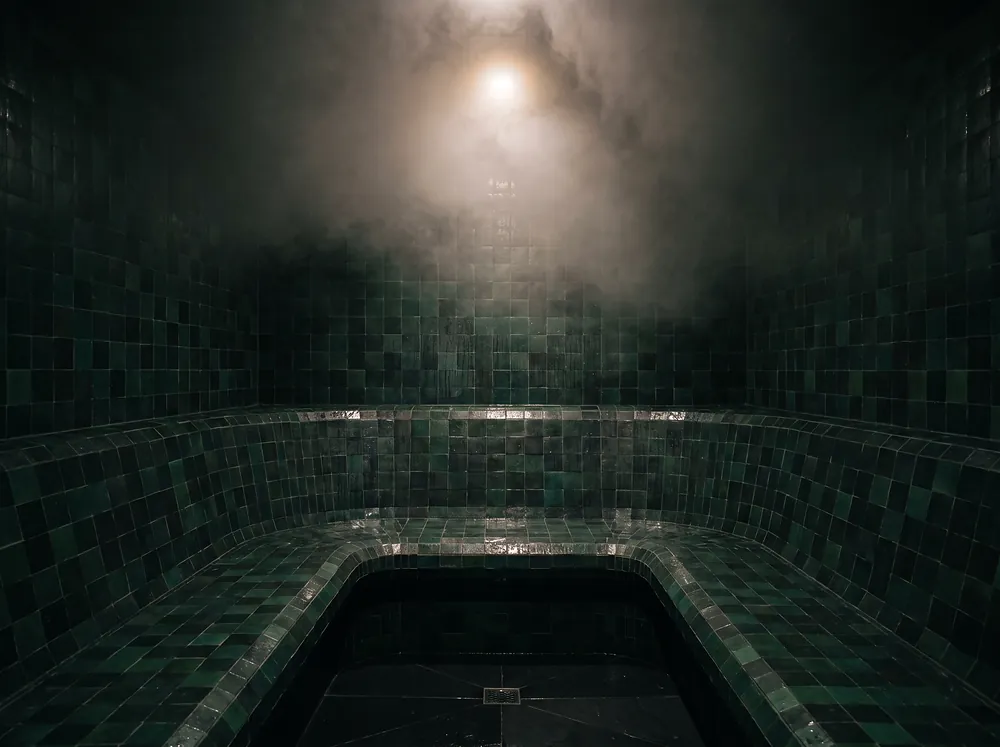
Dry sauna vs steam room: why 45°C wet is harder than 90°C dry
It was never about the temperature. The difference is whether your sweat still has anywhere to go — and the entire building follows from that.

Ice bath benefits: what's real, what's argued about, what's oversold
The first thirty seconds are a reflex you cannot negotiate with. The most reliable effect arrives twenty minutes after you get out.
Sauna health benefits, minute by minute inside a 90°C room
Fifteen minutes at 90°C changes your heart rate, your blood flow and how you sleep that night. The biggest effect arrives after you walk out.
Start with a free survey
We come to your place in Bandung, measure, check the power, and tell you what's possible and what isn't. No cost, no obligation.