What sits inside a Rp 68 million sauna, line by line
A dry sauna for two to three people starts at Rp 68,000,000. That's the number. Now here is where it comes from — line by line, including the line that usually shows up in week three, once it's far too late to re-budget.
Home sauna cost estimates rarely blow up because someone picked the wrong timber. They blow up over something printed in no brochure: the distance from the cabin to your electrical panel.
Home sauna cost: where the number comes from
The table below is for a 2–3 person indoor dry sauna. The left column isn't a marketing figure — it is the Rp 68 million sauna from our pricing page, added up from its parts. The right column is the same cabin in cedar, with a full glass wall and digital control.
| Component | Range (Rp million) | Why it swings this far |
|---|---|---|
| Interior timber + frame | 18 – 32 | Hemlock, thermo-aspen or cedar; and cabin volume |
| Heater + controller | 11 – 20 | 6 kW manual dial vs 9 kW digital control |
| Insulation + vapour barrier + ventilation | 5 – 9 | Invisible. Not negotiable. |
| Glass (tempered door, panels) | 7 – 16 | Door only vs a full glazed wall |
| Benches + joinery | 8 – 14 | Two tiers, radiused edges, knot-free seating faces |
| Electrical work | 3 – 12 | Dedicated line, run length to panel, PLN supply upgrade |
| Lighting | 2 – 5 | One heat-rated fitting vs concealed LED |
| Heater stones + accessories | 2 – 4 | Stones, bucket, ladle, thermometer, backrests |
| Installation labour | 12 – 18 | Access, floor condition, ceiling height |
| Delivery | 0 – 4 | Included within Bandung city |
| Total | 68 – 134 | The left column is that Rp 68 million sauna |
The final figure always comes out of a site survey, not a table. But the table tells you something more useful than a single price: where your money can move.
Timber: species and volume, not just square metres
Two variables move here. Species — hemlock is the affordable end, thermo-aspen sits in the middle, cedar is the top — and cabin volume, which climbs fast because you are lining six surfaces, not one. A cabin 20% larger is not 20% more timber; it's usually more. We compare the species properly in best wood for a sauna.
Heater and controller
A 6 kW heater with a mechanical dial sits at the bottom. A 9 kW unit with an external digital controller, timer and scheduling sits at the top. The gap is real but undramatic — and heater sizing is the worst possible place to economise, for reasons below.
Insulation, vapour barrier, ventilation
Rp 5–9 million on things no guest will ever see. These are also the first three lines a cheaper quote deletes. In Bandung's climate — 750 m altitude, humid, evenings at 18–20°C — all three work harder than they would in Jakarta, because the temperature gradient across the cabin wall is steeper and it happens more often.
Glass
A standard tempered door is already in the bottom column. A full glazed wall facing the garden adds Rp 8–10 million and changes how the room feels more than any other single component. It is simultaneously the most optional line and the one clients approve most often.
Benches and joinery
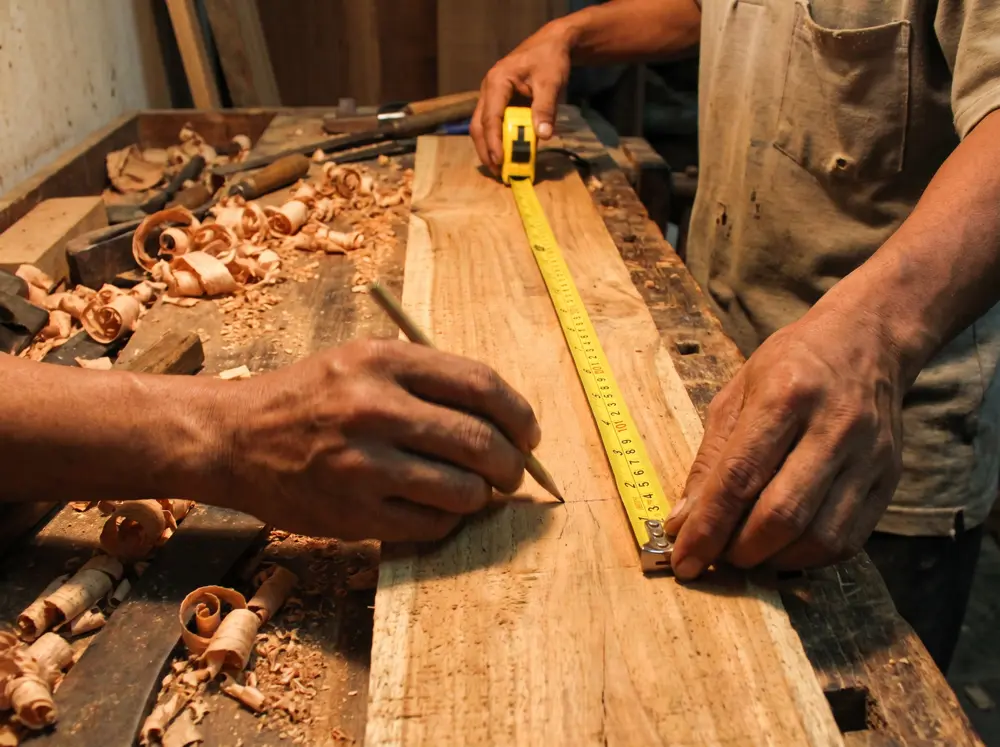
This is where the actual handwork lives. Two-tier benches, radiused edges so they don't cut into your thighs, timber selected knot-free on every seating face — knots hold heat and will burn skin. No screw head appears on any surface you can touch.
Electrical work: the line that surprises people
A 6–9 kW heater does not go into a wall socket. It needs a dedicated line — three-phase or heavy single phase — pulled straight from the panel on its own breaker. If your panel is on the opposite side of the house, that's a long cable run. If your contracted PLN supply isn't large enough, you need a supply upgrade, and that is its own process with its own cost and its own timeline.
The Rp 3–12 million range in the table isn't us hedging. It's the genuine difference between two houses. The detail lives in sauna power requirements.
We check your electrical panel during the site survey — before quoting, not after. If the answer is "your supply needs upgrading", you hear it in week one, not in week three with a finished cabin sitting in your garage.
Installation and delivery
We fabricate in our own workshop, then assemble on site. What drives the labour number: access (narrow staircases are expensive), floor condition, and ceiling height. Delivery is included within Bandung city. Lembang, Dago, Cimahi or Padalarang typically add Rp 1–4 million depending on road access.
Running cost: the honest arithmetic
People rarely write this section because it needs numbers instead of adjectives. Here it is for an 8 kW heater.
Heat-up. A 2–3 person cabin from ambient to 90°C: roughly 40 minutes with the heater drawing near full load. 8 kW x 0.67 h = about 5.4 kWh.
During the session. Once it's up to temperature the heater doesn't run continuously — the thermostat cuts it. Assume roughly a 40% duty cycle. A 60-minute session: 8 kW x 0.4 x 1 h = about 3.2 kWh.
Around 8.6 kWh per session. At a household tariff of roughly Rp 1,450–1,700 per kWh — check your own bill, tariff bands differ — that's Rp 12,000–15,000 a session. Three sessions a week is about 112 kWh a month, or Rp 160,000–190,000 monthly.
That is not a frightening number. What's frightening is an undersized heater.
| Type | Power | Consumption | Note |
|---|---|---|---|
| Dry sauna | 6–9 kW | ~8–9 kWh per session | Heat-up dominates |
| Infrared sauna | 1.8–3 kW | ~1.5–2 kWh per session | Almost no heat-up |
| Ice bath | 0.5–1 HP | ~2–3.5 kWh per day | Holds temperature 24/7, not per session |
An infrared sauna is far cheaper to run — around Rp 2,500–3,500 a session — because it never heats the air. That's a genuine advantage. But it is a different product at 45–60°C, not a budget version of a 90°C sauna.
An ice bath chiller at 0.5–1 HP runs on standard 220V and needs no dedicated line. In Bandung it works less hard than it would in Jakarta: 18–20°C evenings mean the compressor cycles less. Budget Rp 90,000–180,000 a month, heavily dependent on your lid and insulation.
Why a cheap sauna gets expensive
There are Rp 30 million saunas on the market. We know exactly how that number is reached, because we've taken a few of them apart.
Thin timber. 8–10 mm panelling instead of 15 mm and up. Saves millions today. Thin wood moves more on every heat-cool cycle: it cups, it cracks around the fixings, benches flex under two adults.
No vapour barrier. This is the one that actually kills. Inside a sauna, water vapour is driven toward the walls. With no foil layer on the hot side, that vapour passes into the insulation, condenses on the cold side, and never dries. You'll see nothing at all for two years. Then you smell must — and the damage is inside the wall, not on a surface you can sand.
Undersized heater. A 4.5 kW heater in a room that needs 8 kW never reaches 90°C. It runs at 100% duty cycle forever, trying and failing. You pay more electricity for a colder sauna, and the element dies early. It's a saving that inverts its own sign.
No ventilation. With no inlet near the heater and no outlet on the opposite side, air doesn't move and the cabin never dries between sessions. Timber left damp 20 hours a day does precisely what you'd expect.
Add those four together and you get the pattern we see repeatedly: a cheap sauna feels fine in year one, suspicious in year two, and gets demolished in year three. Rp 30 million spent twice, plus removal, costs more than Rp 68 million spent once. That's arithmetic, not a sales argument.
The most expensive part of a sauna is the part you can't see. It's also the first part people delete to hit a price.
If your budget is below that
The honest answer: don't buy a cheaper dry sauna. Buy a different product.
An infrared sauna starts at Rp 42,000,000, plugs into 220V, needs no dedicated electrical work, and costs about a fifth to run. It isn't a 90°C sauna and doesn't pretend to be — but it's a complete product at its price rather than a compromised version of another one. A dry sauna value-engineered down to Rp 40 million is a compromise, and the compromise lives inside the walls.
If your number isn't clear yet, send photos of the room over WhatsApp. Free site survey and 3D layout in the Bandung area, and we'll quote after we've seen your panel — not before.
Frequently asked questions
How much does a home sauna cost in Bandung?
A 2-3 person dry sauna starts at Rp 68,000,000 installed and can reach around Rp 134,000,000 with cedar, a full glass wall and digital control. The line that moves the total most is electrical work, not the choice of timber. The final figure comes after a site survey.
What does a sauna cost to run per session?
For an 8 kW heater, a full session including a 40-minute heat-up uses roughly 8.6 kWh, or about Rp 12,000-15,000 depending on your tariff band. Three sessions a week works out to roughly Rp 160,000-190,000 a month. An infrared sauna is far cheaper at around Rp 2,500-3,500 per session.
Does a home sauna need an electrical supply upgrade?
Often yes. A 6-9 kW heater needs a dedicated line pulled straight from the panel rather than a wall socket, and many houses need their contracted PLN supply increased. That's why we check your panel during the survey before quoting.
Why are there Rp 30 million saunas, and are they worth it?
That price is reached by cutting the things you can't see: thin timber, no vapour barrier, an undersized heater, and no ventilation. In Bandung's humid climate that combination usually means a musty smell by year two and demolition by year three. Buying twice costs more than buying once.
How long does it take to build and install a home sauna?
Typically 3-6 weeks from design sign-off to a finished installation, depending on workshop queue and material availability. Delivery is included within Bandung city; Lembang, Cimahi or Padalarang usually add Rp 1-4 million depending on road access.
Information on this site is educational and is not medical advice. Consult a doctor before starting heat or cold therapy.
Contrast therapy is one system, not two products
It isn't the heat, and it isn't the cold. It's the transition between them. Here is the protocol, number by number.
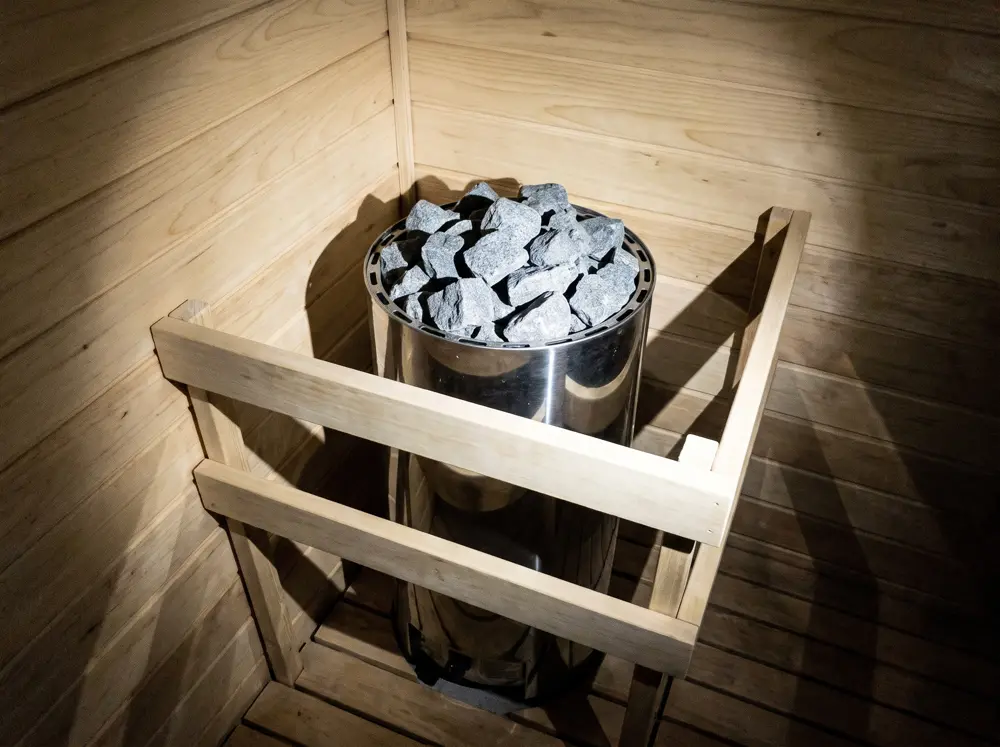
How to use a sauna: seven steps, and the etiquette nobody explains
The top bench runs 15-20°C hotter than the bottom one, and nobody tells first-timers.
There is no ideal ice bath temperature — there is a dose
Ice gives you 5°C at minute zero and 11°C at minute eight. That is not a protocol, it is a coincidence.
Start with a free survey
We come to your place in Bandung, measure, check the power, and tell you what's possible and what isn't. No cost, no obligation.