Sauna wood is chosen with physics, not with taste
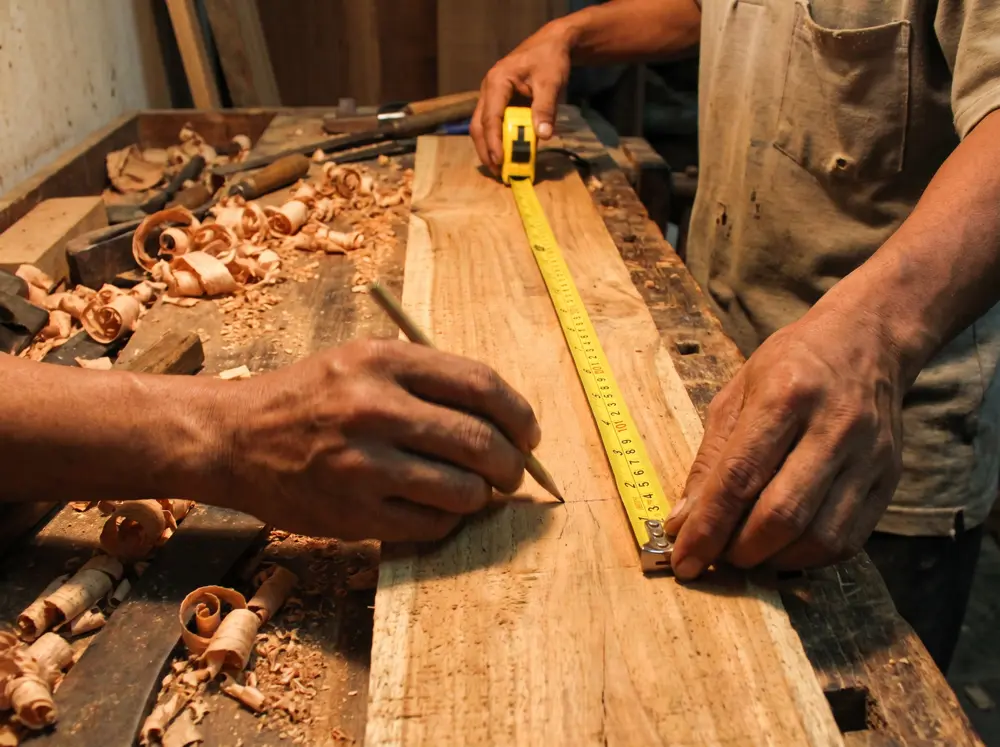
Touch a steel screw head inside a 90°C sauna and your hand pulls back before your brain has decided anything. Touch a cedar bench in the same room, same air, same thermometer, the same 90°C, and nothing happens. You can sit on it for twenty minutes. The whole question of the best wood for sauna interiors lives inside that gap. It is not about taste, colour or scent. It is about how fast a surface moves heat into your skin.
We have been building saunas out of our own workshop in Bandung for three years, and the first question from almost every client is identical: "We can do it in teak, right?" The answer takes more than one sentence.
Why 90°C of steel burns and 90°C of cedar does not
What burns skin is not surface temperature but the rate at which heat flows out of that surface into you. Engineers call it thermal effusivity, and three properties set it: conductivity, density and heat capacity. In wood, all three track one number you can see and feel: density.
Light wood is mostly air. Western red cedar runs about 350–400 kg/m³, roughly two thirds empty cells full of air, and air insulates. It cannot hand its heat to your skin quickly because the heat cannot travel quickly inside the wood. Teak sits around 630–700 kg/m³, and bangkirai is heavier still. The denser the wood, the faster it empties its heat into your palm.
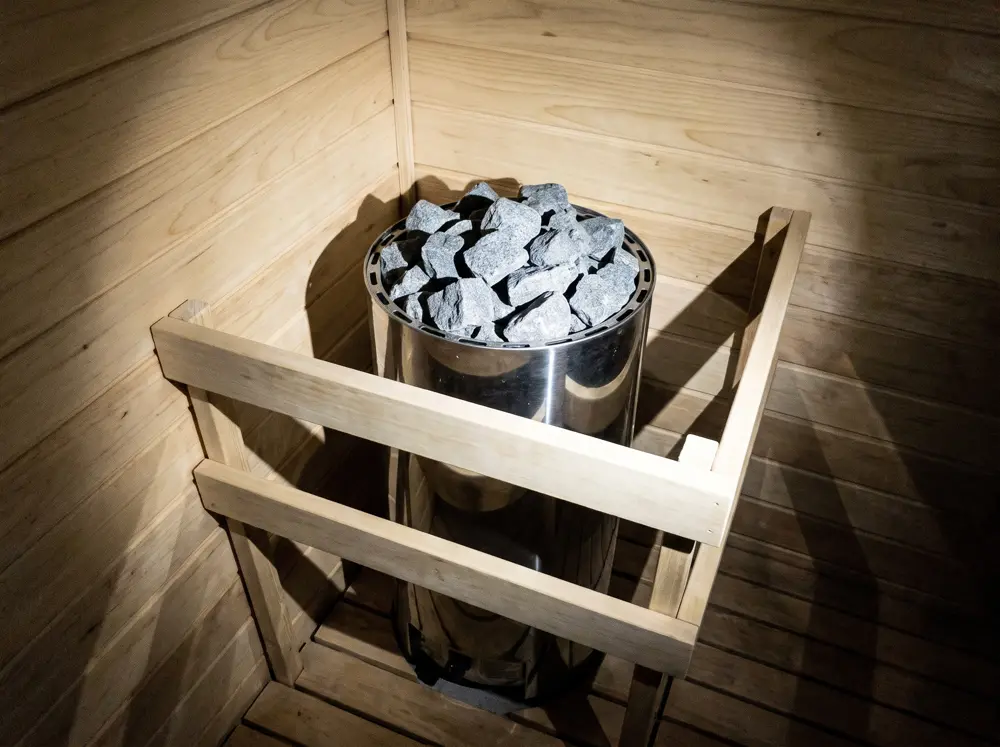
Rough numbers: cedar conducts at about 0.10 W/m·K, teak about 0.16, stainless steel about 15, plain carbon steel about 50. That is not a difference in percent, it is two orders of magnitude. Which is why one workshop rule is not up for discussion: no metal you can touch inside the hot room. Bench screws go in from underneath, hinges and handles are timber or shielded, the heater gets a wooden guard. If one bolt head sits proud on a backrest, sooner or later a bare back finds it.
The same rule explains why knots have no business in a bench slat. A knot is far denser than the wood around it, and resinous: one knot mid-bench is a small hot spot waiting for a guest. On a wall panel knots are fine. On skin-contact surfaces, never.
Resin: why pine bleeds inside a hot room
The second criterion is what comes out of the wood when you cook it. Pine has large, numerous resin canals. At 80–95°C that resin liquefies and weeps out as sticky, hot droplets, and a 90°C bead on a bare thigh is considerably less pleasant than the timber it came from. Resin also darkens, transfers to towels, and smells sharp.
This is why pine does not appear inside a properly built sauna, despite being cheap and in every timber yard. Nordic spruce has far fewer and much smaller resin canals, and that is the real reason it became the Finnish standard for sauna walls. Not tradition, not aesthetics.
There is a way out for resinous or unstable species: heat treatment. Thermowood is baked at 180–215°C in low oxygen for several hours. The process cooks resin and sugars out of the fibre and breaks down part of the hemicellulose. What comes out is timber far more reluctant to absorb moisture, more stable, more rot resistant, and caramel brown. Thermo-aspen is the best bench material you can buy for sensible money.
The honest side: thermowood is more brittle. It loses bending strength and splits if you screw close to a board end without pre-drilling. It is also dark, so if a client wants a pale, bright interior, thermowood is not the answer. We use it on surfaces, never structurally.
No varnish, paint, lacquer or stain inside the hot room, whatever the brand promises. A film finish blisters at 90°C, traps moisture behind itself, and off-gasses into a small sealed space you are breathing with open pores. Sauna timber is left bare. The only treatment we allow is sauna-grade paraffin oil on bench tops, purely because it resists sweat staining. The same rule covers plywood and MDF: urea-formaldehyde and 90°C are not a combination you want in a six-cubic-metre room.
Wood moves, and in Bandung it moves harder
This is the criterion most often ignored, and the one that wrecks saunas two years after handover. Wood does not move because of heat but because of moisture: it takes up water vapour and swells, gives it back and shrinks. A sauna is a humidity-cycling machine, running from damp room air to 90°C at 10–20% relative humidity and back, three times a week, for ten years.
In Finland, indoor air during the heating season is already dry, so that cycle is modest. Bandung sits at 750 m, with 18–20°C evenings and high humidity nearly year round. The gap between the timber's moisture content between sessions and during one is far wider here. Same wood, different climate, different outcome.
The consequences are practical and expensive. A board installed at 16–18% moisture content drops to roughly 6–8% within months. A 120 mm board can shrink one to two millimetres, and if it is nailed hard on both edges it does not shrink, it cracks. So three things we never skip:
- Kiln-dried, not air-dried. Only timber dried in a kiln to a low, controlled moisture content. "Dry" wood that has sat in a yard does not qualify, however long it sat there.
- Acclimatisation in the destination city, not at the port. Timber sits in the workshop for weeks before a machine touches it, so it finds equilibrium with Bandung air first, not after it is screwed to a client's wall.
- Joints that permit movement. Tongue and groove with expansion room, floating panels, no cross-grain glue-ups, no wide boards pinned at both ends.
Ventilation and a proper vapour barrier are the mandatory partners to all this, and here they matter more than in Jakarta: the air entering the cabin already carries water.
Best wood for sauna: the comparison table
The figures below are typical ranges, not constants. Wood is biological and every board differs. What matters is the running order, not the exact number.
| Species | Density (kg/m³) | Conductivity (W/m·K) | Resin | Scent | Where it belongs |
|---|---|---|---|---|---|
| Western red cedar | 350–400 | ~0.10 | None | Strong, fades in 3–5 years | Benches and walls |
| Thermo-aspen | 400–450 | ~0.11 | Baked out | Almost none | Benches, backrests, headrests |
| Untreated aspen | 400–450 | ~0.11 | None | None | Benches in a well-ventilated cabin |
| Nordic spruce | 420–470 | ~0.12 | Slight | Light | Walls and ceiling |
| Hemlock | 450–500 | ~0.11 | None | Almost none | Walls; the budget pick |
| Pine | 450–550 | ~0.12 | Heavy | Sharp | Avoid inside the cabin |
| Teak | 630–700 | ~0.16 | Natural oils | Light | Exterior and outer door frames |
| Merbau / bangkirai | 800–900 | ~0.18–0.22 | Tannin | Neutral | Outdoor decking, feet, outer frame |
So can you build with Indonesian timber?
The honest answer is yes, but almost never where people are hoping.
Teak is a remarkable wood: stable, rot resistant, naturally oily, beautiful. It is also dense, roughly twice cedar, and that density is what makes it more conductive. A teak bench at 90°C is not impossible, but it bites when skin lands on it, and its oils can weep at sauna temperature. Add the price and you are paying a premium for a property that works against you. Teak is a premium furniture wood, not a premium sauna wood.
If someone offers you a "teak sauna" as their top tier, that is a marketing argument, not a technical one. We get asked often enough, and decline often enough, that it is worth saying out loud.
Merbau, bangkirai and ulin are dense tropical hardwoods. Outdoors they are superb: they shrug off rain, resist termites, last decades. Inside a sauna they are wrong on nearly every criterion: too dense, too conductive, and merbau leaches tannin that stains anything wet it touches, white hotel towels included. Meranti is cheap but unstable and resinous. Sungkai and mahogany have no case inside a hot room.
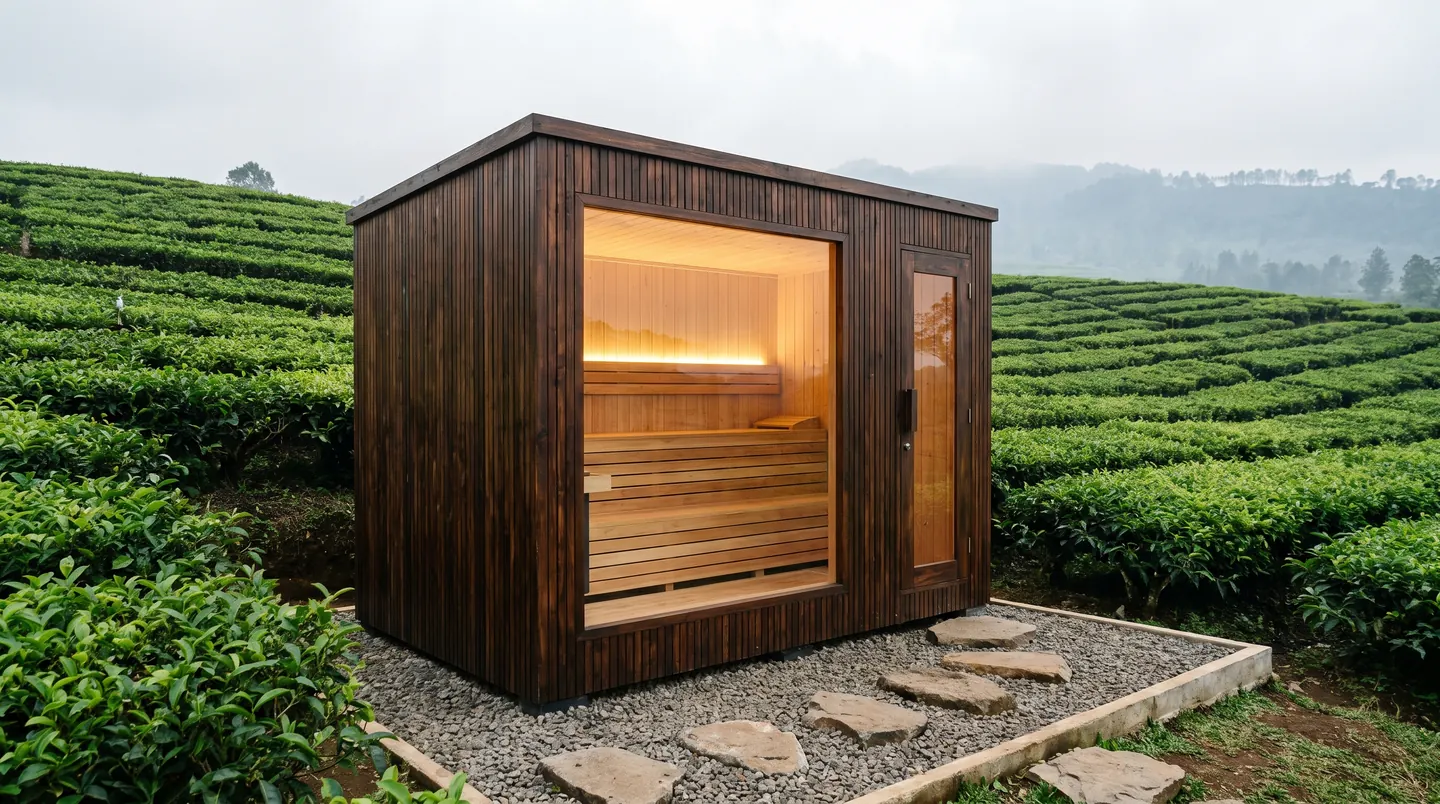
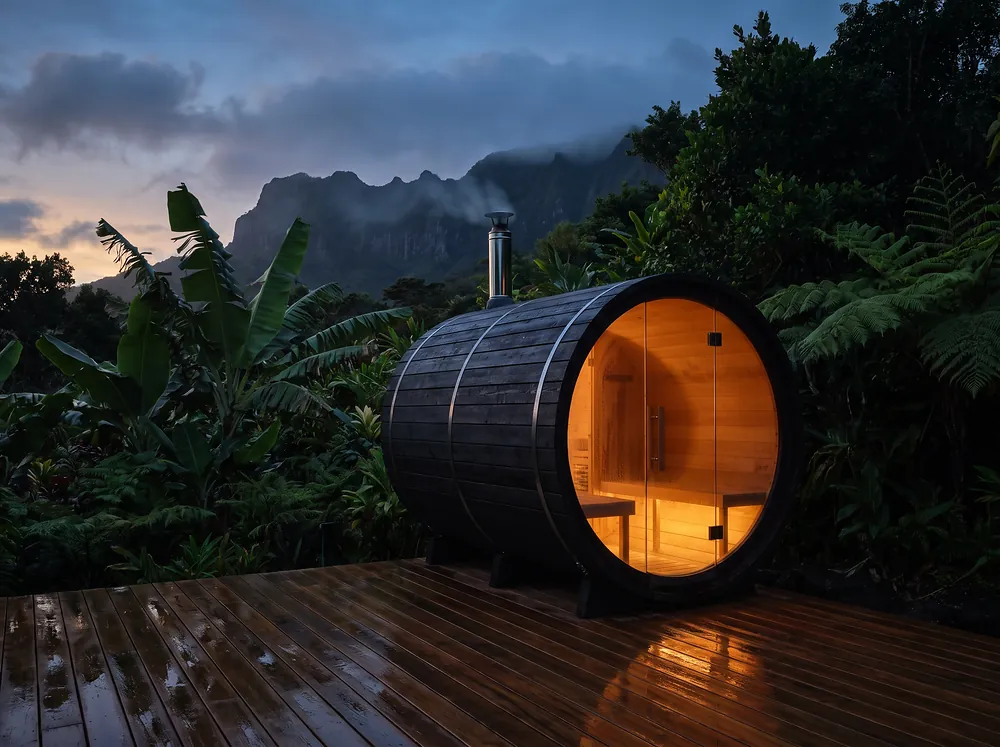
Where local timber earns its place is outside the cabin: exterior cladding on a barrel, the frame and feet, decking around an ice bath, outer door frames. Out there the density and natural oils of teak or bangkirai flip from liability to advantage, and the timber is already here rather than shipped in. We use that split on nearly every barrel sauna we deliver: cedar or thermo-aspen inside, hardwood on the skin.
What we actually specify
Our standard build is not complicated:
- Benches, backrests, headrests: thermo-aspen or knot-free cedar. Screwed from below, edges rounded, slats gapped 8–10 mm.
- Walls and ceiling: kiln-dried cedar or Nordic spruce, tongue and groove, over a vapour barrier and a ventilated cavity.
- Heater guard and trims: the same timber as the benches. Never bare metal.
- Exterior: thermowood, or local hardwood where the site demands it.
Sauna wood is not chosen for how it looks. It is chosen for how slowly it surrenders its heat to your skin.
If you are costing a project, species choice moves the number less than most expect: the big swings come from cabin size and heater rating. Our home sauna cost breakdown splits it by component, and the home sauna size guide explains why cabin volume drives everything else. Look at the dry sauna specification, or book a free site survey: we arrive with a tape measure and wood samples, and you can hold both at room temperature before you commit.
Frequently asked questions
What is the best wood for sauna benches?
Thermo-aspen or knot-free western red cedar. Both are light, resin-free, and sit around 0.10–0.11 W/m·K thermal conductivity, so they do not burn skin at 90°C. Choose aspen if you dislike scent, cedar if you want it.
Can you build a sauna out of teak?
Teak works for exteriors, door frames and decking, but it is the wrong choice for benches. At roughly twice the density of cedar it moves heat into skin much faster and bites when you sit on it. You also pay a premium price for a property that hurts you in a hot room.
Why can't you use pine inside a sauna?
Pine has large, plentiful resin canals. At 80–95°C the resin melts and weeps out as hot, sticky droplets that stick to skin and towels and darken the timber. Nordic spruce is used instead because it has far fewer resin canals.
How long does cedar smell last in a sauna?
The scent is strongest in the first year and usually fades noticeably within three to five years of regular use. A light sanding of the surface will wake it up again for a while. If scent is not what you are after, aspen is the quieter choice.
Should sauna wood be varnished, sealed or oiled?
Never varnished, painted or lacquered. Film finishes blister at sauna temperature, trap moisture behind them, and off-gas into a small sealed room. The only sensible treatment is a sauna-grade paraffin oil on bench tops, purely to resist sweat staining.
Information on this site is educational and is not medical advice. Consult a doctor before starting heat or cold therapy.
What sits inside a Rp 68 million sauna, line by line
Budgets rarely blow up over the timber. They blow up over one line that appears in no brochure: your electrical panel.
Contrast therapy is one system, not two products
It isn't the heat, and it isn't the cold. It's the transition between them. Here is the protocol, number by number.
How to use a sauna: seven steps, and the etiquette nobody explains
The top bench runs 15-20°C hotter than the bottom one, and nobody tells first-timers.
Start with a free survey
We come to your place in Bandung, measure, check the power, and tell you what's possible and what isn't. No cost, no obligation.