Dry sauna vs steam room: why 45°C wet is harder than 90°C dry
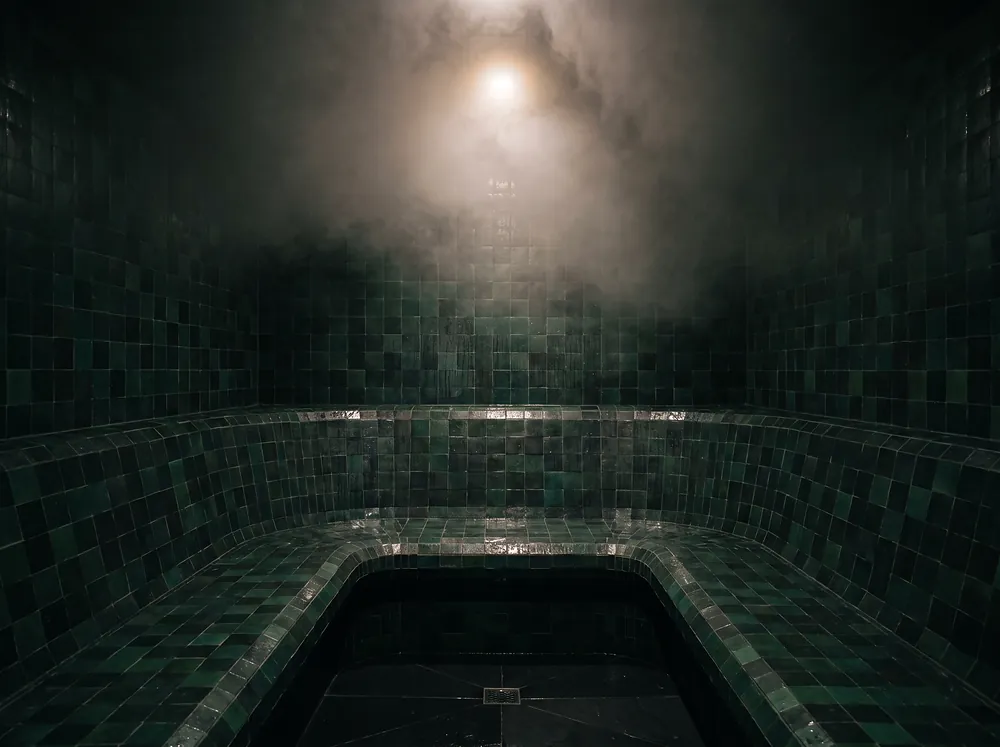
Put two thermometers in two rooms. One reads 90°C, the other 45°C. Spend ten minutes in each and guess which sends you looking for the door first. Almost everyone gets it wrong.
The dry sauna vs steam room question is nearly always settled with those two numbers, and those two numbers lie. What separates the rooms is how the heat reaches your skin, and whether your body can push back. Everything else — timber or tile, foil or membrane, drain or no drain — follows from that.
Why 45°C wet beats 90°C dry
Once air temperature passes your skin temperature — around 33–35°C — you lose two of your three cooling routes. Convection is finished: the air is hotter than you, so it delivers heat rather than removing it. Radiation too; the walls are hotter than you. One route stays open: sweat evaporation.
And that route is powerful. Every gram of sweat that evaporates carries away roughly 2.4 kJ — about 0.6 kcal per gram — enough to offset several hundred watts. At 80–95°C and 10–20% humidity it runs wide open: sweat forms, evaporates, disappears. Your skin is working, and winning. That's why 90°C isn't merely survivable. It's pleasant.
At 40–48°C and 100% humidity, that route isn't narrow. It's zero. The air is saturated; it cannot accept one more gram of vapour, so your sweat forms and sits there. Worse: because your skin is cooler than saturated 45°C air, the vapour condenses onto you, and condensation releases that same latent heat straight into your skin. Your only cooling channel closes and a heating channel opens. That's the whole answer.
If you've ever ladled water onto sauna stones and felt the wall of heat arrive two seconds later, you've met this mechanism. The air temperature barely moves; what changes is vapour condensing on your skin. Technically, a steam room is that löyly moment held permanently, at half the air temperature.
One thing rarely mentioned: radiant load. A 90°C surface radiates onto your skin at roughly 400 watts per square metre; a 45°C surface, well under 100. The steam room works quietly — and because it's quiet, people overstay.
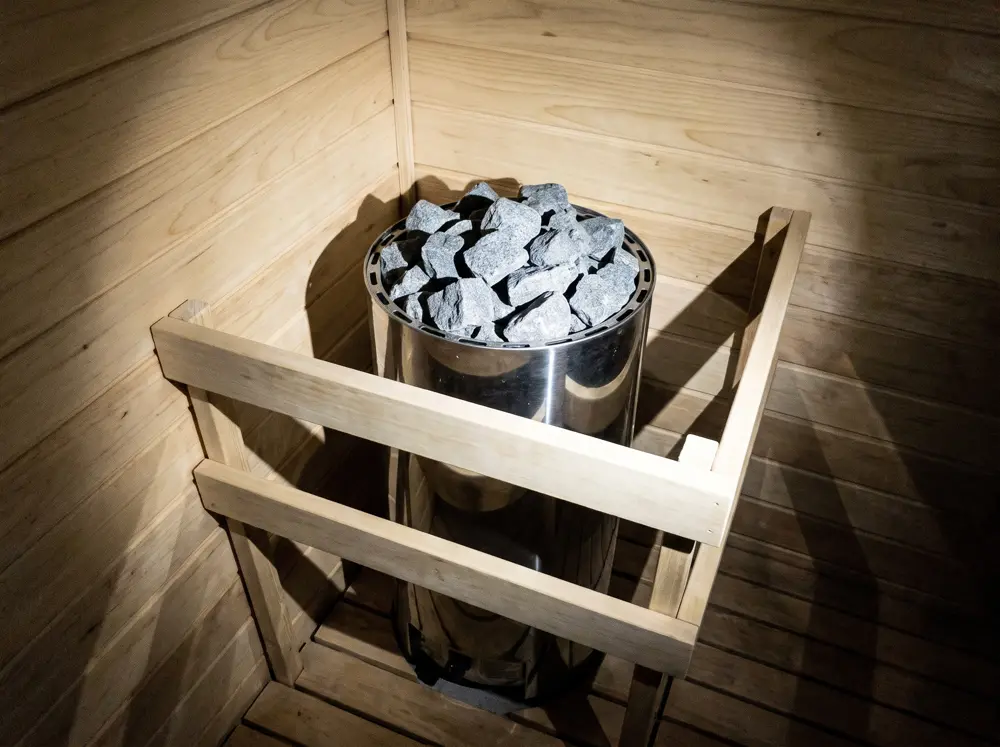
Two rooms, two completely different buildings
Dry sauna: timber, foil, and one air gap
A dry sauna wall is a sandwich: frame, 50–100 mm of mineral wool, aluminium foil on the warm side with every seam taped shut, a 15 mm cavity, then cladding. The foil isn't a decorative heat reflector. Its job is to keep vapour out of the insulation, where it would condense and quietly rot your frame over three years without announcing itself. The cavity gives whatever still gets through a way out.
The interior is bare timber — cedar, thermo-aspen or hemlock — unvarnished, uncoated. Timber because its thermal conductivity is low: you can sit on a 90°C wooden bench, you cannot sit on a 90°C tiled one. Species choice is covered in our guide to the best wood for a sauna. A floor drain here is nice to have, nothing more. The room is dry. That's the point.
Steam room: six waterproof surfaces
A steam room is a wet room, one hundred per cent. Six surfaces — floor, four walls, and the ceiling — must be tanked before any tile goes on. No timber: wood at permanent 100% RH is an invitation to mould.
The detail most often missed: the ceiling has to slope, roughly 1:10, so condensate runs down the walls instead of dripping on your head. A flat ceiling in a saturated 45°C room drops hot water on your scalp every fifteen seconds, and it's the one complaint you cannot fix without taking the ceiling apart. A floor drain is mandatory, floor falling toward it, trap that must never dry out. The generator lives outside in a service cupboard: water supply, blowdown drain, its own power.

Dry sauna vs steam room, side by side
| Dry sauna | Steam room | |
|---|---|---|
| Air temperature | 80–95°C | 40–48°C |
| Humidity | 10–20% | 100% |
| How heat arrives | Radiation + convection | Conduction + vapour condensing on skin |
| Does sweat evaporate? | Yes — it's your main coolant | No. Zero |
| Radiant load | Order of 400 W/m² | Under 100 W/m² |
| Interior material | Bare timber (cedar, thermo-aspen, hemlock) | Tile, stone or acrylic |
| Vapour control | Aluminium foil + air cavity | Full tanking membrane, six surfaces |
| Floor drain | Optional | Mandatory |
| Ceiling | Flat is fine | Must fall, around 1:10 |
| Heat source | 6–9 kW heater + stones, dedicated circuit | Steam generator + water supply + drain |
| Warm-up time | ~45 min | ~15 min |
| Energy per session (est.) | ~9 kWh | ~4 kWh |
| Routine maintenance | Sweep benches; restack stones every 2–3 years | Descale generator, grout, extract after every session |
| Partner for an ice bath | Ideal | Works, but a smaller contrast |
| From | Rp 68,000,000 | Rp 55,000,000 |
The Bandung factor: the outside air is already wet
Bandung sits at 750 metres, evenings fall to 18–20°C, and the air is humid year-round. If you arrived from northern Europe or the Gulf, your instincts about how buildings dry out do not transfer here.
First, a vapour barrier mistake will not heal itself. In a dry climate, vapour that leaks into a wall cavity evaporates back out when the weather turns. Here the air available to dry it is close to saturated already. What gets in, stays — which is why taping every foil seam isn't cosmetic.
Second, the practical one: you cannot dry a steam room by waiting. That's arithmetic, not opinion. Saturated air at 45°C carries about 65 grams of water per kilogram. Bandung night air at 19°C and 90% RH already carries about 12 — and used to flush a room that has also cooled down, it picks up only a few grams more. The gap is roughly tenfold. Run the extract after the room has cooled and you're pushing damp air through a wet room; next morning it's still wet. Repeat for three months and the grout will tell you about it.
Run the extract while the room is still hot, not after it cools. A 20–30 minute timer after the last session pulls out several times more water than a fan starting at seven the next morning. If you run a hotel, this is the detail that decides whether your steam room still smells right in year three: a room used by forty guests a day never gets a natural dry window, so you have to engineer one.
Running cost, and who bills you later
The order runs opposite to most people's assumption: the steam room is cheaper to run, and the dry sauna asks for almost nothing once built.
Rough numbers for one domestic session — assume the thermostat runs about 40% of the time once up to temperature, which moves with insulation and how cold the evening is. An 8 kW heater spends around 6 kWh on the 45-minute warm-up alone, plus roughly 3 kWh across a one-hour session: call it 9 kWh. A domestic steam generator reaches temperature in 15 minutes and holds it on far less — near 4 kWh, plus a few litres of water.
Maintenance flips the order back. Dry sauna: sweep the benches, light sand occasionally, restack the stones every two to three years. Stones fracture and pack down, airflow through the heater chokes, the element runs hot and dies young. That's the whole list. Steam room: descale the generator (frequency depends on water hardness — the one genuinely recurring cost), the grout, and an extract fan that actually gets run every session. The opponent is mould, and mould doesn't take days off.
Prices start at Rp 55,000,000 for a steam room and Rp 68,000,000 for a dry sauna — full price list here. Don't read that gap as fixed: dry sauna pricing is stable because the cabin is self-contained, while steam room pricing turns on how much waterproofing and drainage has to be torn out and redone.
The thermometer tells you the air temperature. What decides how hard the session is is whether your sweat still has somewhere to go.
So which one is yours?
- Dry sauna if you're pairing it with an ice bath — that 400 W/m² radiant load is what makes the plunge feel like a switch being thrown, and sequencing is in our contrast therapy guide; or you want löyly; or you want to build it and forget it. One condition: a 6–9 kW heater needs its own circuit.
- Steam room if 90°C dry air bothers your sinuses or skin; you're after the hammam ritual; guests ask your hotel for one; or you already have a real wet room that needs only upgrading.
- The third option if you want a gentler temperature with no water at all — an infrared cabin, compared head to head in infrared vs traditional sauna.
Research on heat and the body is interesting but unsettled. Many users report better sleep and looser muscles — a different claim from a medical one. What is certain: both rooms load your circulation, and the steam room loads it more quietly precisely because you don't feel "overheated" as fast, so people overstay. If you're pregnant, have a heart condition, uncontrolled high blood pressure, or epilepsy, speak to a doctor first — same as before any cold exposure.
We build both across Bandung and West Java, and have no stake in pushing you either way. Start with a site survey and 3D layout, free inside Bandung. Usually your room's shape and the nearest drain answer the question before taste gets a vote. WhatsApp.
Frequently asked questions
Which is better, a dry sauna or a steam room?
Neither is better — they sell different experiences through different mechanisms. A dry sauna wins if you want löyly, near-zero maintenance, and a partner for an ice bath. A steam room wins if 90°C dry air is too harsh on your sinuses or skin, or if the hammam ritual is what you're actually after.
Why does a 45°C steam room feel hotter than a 90°C sauna?
Because at 100% humidity your sweat cannot evaporate at all, and evaporation is the only cooling route your body has left once the air is hotter than your skin. On top of that, vapour condenses onto your cooler skin, and condensing water releases its latent heat directly into you. In a dry sauna the sweat evaporates freely and your cooling system runs at full capacity.
Can a steam room be fitted into an existing bathroom?
Often yes, and it's usually the most economical route because the drainage and basic waterproofing are already there. What normally has to be added is tanking all the way up to the ceiling, a sloped ceiling so condensate doesn't drip on your head, dedicated extraction, and a nearby service cupboard for the steam generator. We check feasibility during the site survey.
How much does a steam room cost in Bandung?
From Rp 55,000,000, and the spread is wider than for a dry sauna because the price depends so heavily on the condition of the existing space. A room that's already a wet room with the drain in the right place is far cheaper than a dry room that has to be stripped back to structure. Typical lead time is 3–6 weeks.
Does a steam room need a floor drain?
Yes, always. The room produces condensate continuously while it runs, and that water needs a defined destination with the floor falling toward it. The trap also has to be kept from drying out. A dry sauna is different — there a floor drain only makes cleaning easier.
Information on this site is educational and is not medical advice. Consult a doctor before starting heat or cold therapy.

Ice bath benefits: what's real, what's argued about, what's oversold
The first thirty seconds are a reflex you cannot negotiate with. The most reliable effect arrives twenty minutes after you get out.
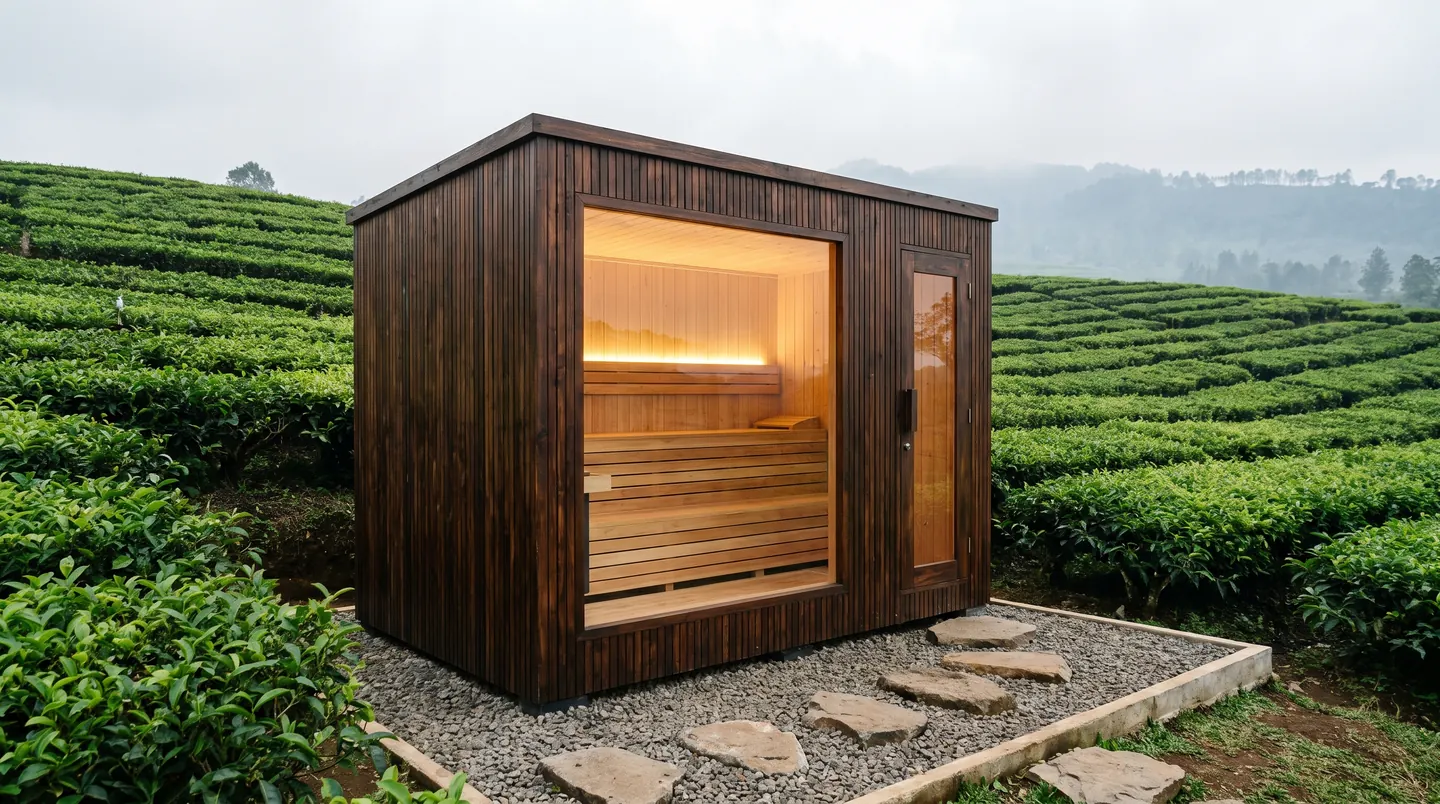
Sauna health benefits, minute by minute inside a 90°C room
Fifteen minutes at 90°C changes your heart rate, your blood flow and how you sleep that night. The biggest effect arrives after you walk out.
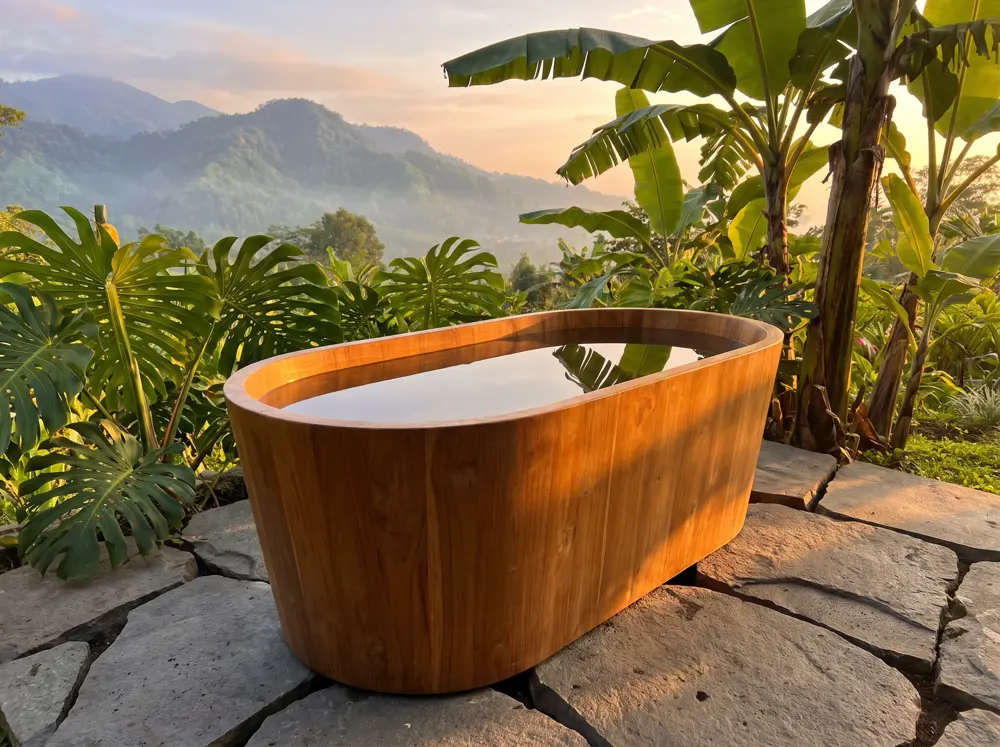
Try it with a tub and bagged ice before you think about Rp 38 million
Almost everyone still using an ice bath a year later did it the cheap, uncomfortable way first.
Start with a free survey
We come to your place in Bandung, measure, check the power, and tell you what's possible and what isn't. No cost, no obligation.